Executive Summary
- Regulations from the past five years from federal agencies will raise everything from the cost of household goods, vehicles, and utilities; in the aggregate, these regulations will make it costlier for consumers.
- Based on the agencies’ own projections, a hypothetical individual consumer who would buy all of the affected products, could expect to cumulatively pay upwards of an additional $8,000 in a given year (some commercial consumers could see additional higher costs of $83,463) for goods due to recent regulatory actions.
- The cumulative effect of these regulations will be a lower variety of goods, lower economic output, and higher prices which is especially critical during a time of inflation.
Introduction
American Action Forum (AAF) research has concluded 20 regulations enacted over the past five years will harm economic growth and increase costs by more than $8,000 per capita in a given year (some commercial consumers could see additional higher costs of $83,463) for businesses and consumers. Higher-priced vehicles, pricier household goods, and the increase in the cost of utilities make it clear that increased regulation, on the aggregate, has measurable quantitative effects on the average American consumer and profound implications for consumers and the broader economy.
Methodology
AAF reviewed recent federal regulatory rulemakings (using a similar methodology of past research), that would have an annual impact on the economy of greater than $100 million and were deemed “economically significant.” Many agencies who authored these rules recognized that these regulations would lead to increased costs for consumers even if they did not explicitly describe the quantitative effects.
For example, the Environmental Protection Agency (EPA) concludes that their new regulations for air pollution from heavy-duty motor vehicles will “increase the cost of producing and selling compliant HD [heavy-duty] vehicles” which “are likely to lead to increases in prices for HD vehicles.” However, the EPA does not quantify these new costs due to “data limitations.”[1]
While there are numerous examples of agencies giving a qualitative answer about costs rising from the EPA[2] to the Department of Transportation, the Food and Drug Administration, and the Department of Commerce; this report focuses on the agencies’ own quantitative estimates of their rules.
In terms of measurable, quantitative price changes, AAF divided the findings into five categories.
Vehicles: $5,346
Housing: $1,294
Goods: $475.93*
Energy: $194.97
Water: $30
* In the course of researching these price increases, there were two outliers that dramatically increased the cost of commercial packaged boilers and air compressors in the amount of $83,463. This figure was excluded from the main findings as it is outside of the scope of more typical consumer goods.
All costs were taken directly from the rules’ reports or their Regulatory Impact Analysis (RIA).
Results
Vehicles
Recent regulations pertaining to vehicle sales make up the bulk of total consumer cost increases. A Department of Energy (DOE) rule regulating the energy conservation standards for electric motors will result in $4,386 in increased costs across 6 different product price increases. The Department of Transportation (DOT) also finalized a rule altering the fuel economy standards for passenger cars and light trucks produced from 2024 —2026 which is projected to cost consumers $960.
Housing
A DOE rule regulating the energy efficiency standards for the design and construction of new federal low-rise residential buildings will result in a “national average incremental cost increase of $2,336 ” for a single-family household. This was determined by comparing the cost of a home under the 2021 International Energy Conservation Code (IECC) to the cost of a home under the 2015 IECC.
The rule also projects an increase in cost for a multi-family house of $1,294 comparing the price of a multi-family home under the 2021 IECC to the price of a multi-family home under the 2015 IECC.
Goods
The Department of Energy (DOE) and the Department of Housing and Urban Development (HUD) spared no expense in regulating a wide variety of goods. The following list denotes some price increases deriving from regulations for some common consumer items:
- Portable Air Conditioners: $228 (split among three different classifications of products)
- Air Cleaners: $5
- Alarms[3]: $20-50
- Outlets[4]: $140-160
- Lamps: $9.19 (residential), $22.93 (commercial)
Some commercial consumers may see increasingly large bills for products like commercial boilers and air compressors. The DOE finalized a rule regulating the energy conservation standards for commercial packaged boilers which resulted in price increases totaling $77,187 across eight different products. While this is by far the most expensive price increase deriving from recent regulations, it applies to only a small number of consumers.
Similarly, the DOE also recently finalized new energy conservation standards for air compressors totaling $6,276. Again, while this product is not eagerly demanded by the general public, some consumers may find it far more difficult to purchase newer air compressors.
Energy
Three recent rules from the Environmental Protection Agency (EPA) and the Department of Energy (DOE) will increase the cost of energy in both terms of megawatt hours (MWH) and the cost of uninterruptible power supplies.
A Trump-era EPA rule revising emissions guidelines resulted in a $12 – $55 increase in MWH consumption. According to the Energy Information Administration, the average American household consumes 10.57 MWH annually.
A more recent Biden-Administration ruling from the DOE regulating the energy conservation standards from uninterruptible power sources is increasing prices by $153 spread across three different product classifications.
Water
A recent EPA regulation revising the Lead and Copper Rule will affect the annualized incremental cost per household of water ranging from $5 – $30 depending on the household’s community water system category.
Implications
In addition to the increased costs that consumers face, these regulations have more extensive effects on the wider economy. Some reports state that higher prices resulting from these regulations will result in decreased sales in the long term and could potentially create a period of pre-buying “ in anticipation of potentially higher prices.”[5]
While a recent rule from the Department of Commerce pertaining to regulations regarding fishing in the Northeast did not quantify an individual cost to consumers, it contained insights about producer and consumer surplus as well as the total supply of seafood. This one fishing regulation is projected to decrease producer and consumer surplus by $104,000,000 while also decreasing the total amount of seafood caught by 11.5 million pounds.
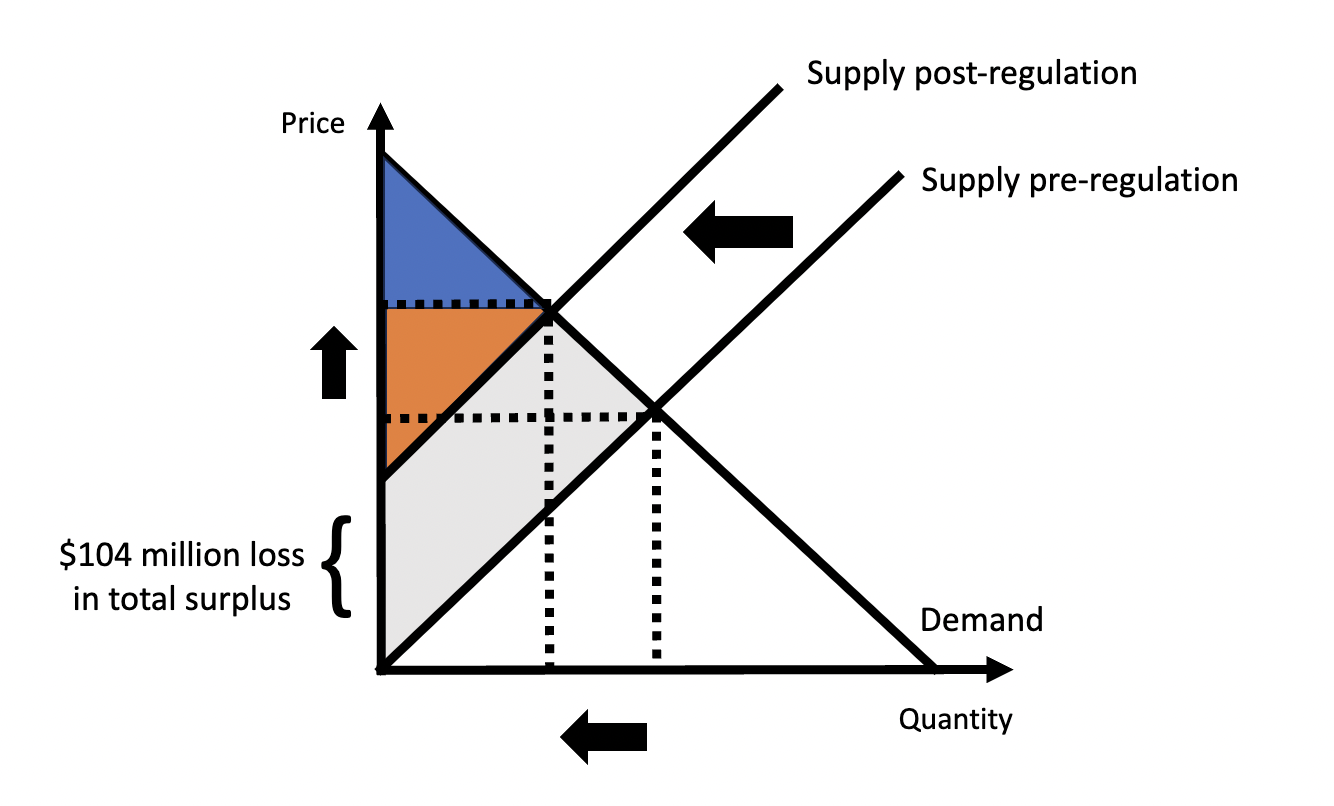
As displayed in the graph, the supply of seafood pre-regulation is greater than the supply post-regulation. This greater supply allows for a lower price and increased consumer consumption. Therefore, the producer and consumer surplus are the blue, orange, and gray areas. However, due to the regulation, the supply has contracted (represented by the leftward shift of the supply curve) which results in the consumer and producer surplus being just the orange and blue areas. The loss of the gray area as surplus amounts to a $104 million loss in this market. The regulation will consequently result in higher prices and less quantity supplied. When considering regulations in terms of surplus lost, the effects of overbearing bureaucracy become clear.
Conclusion
Countless regulations from a wide variety of federal organizations recognize that their own rules will cost American consumers; however, they fail to quantify these costs. Whether these implicit additional costs come in the form of higher airline prices, more expensive goods, or food, Americans will continue to pay higher prices, even if the federal government cannot quantify the effects of these regulations.
Eight thousand dollars is an expensive bill, especially when considering it comes from just a few, recent regulations. Commercial consumers looking at bills over $80,000 of what they would have paid just a few years ago may be left feeling confused and outraged. Regardless of whether or not the government can quantify these costs or not, it is clear that regulations aimed at businesses ultimately end up costing the consumer.
[1] See Page 407 of the Regulatory Impact Analysis
[2] See Page 7 of the Regulatory Impact Analysis
[3] See Pages 27-28 of the Regulatory Impact Analysis
[4] See Page 28 of the Regulatory Impact Analysis
[5] See Page 49 of the Regulatory Impact Analysis
 Policy Interns
You must be logged in to post a comment.