
The Centers for Medicare & Medicaid Services (CMS) published its Current Year (CY) 2026 Physician Fee Schedule (PFS) and related policy updates on November 5. While the final rule spans a wide range of Medicare payment and operational policies, the information collection request associated with the Medicare Prescription Drug Inflation Rebate Program introduces a particularly significant administrative expansion. CMS finalized a voluntary 340B claims “repository” that will accept data submissions beginning in 2026 solely for usability testing. Although the repository will not be used to calculate rebates during this period, the associated information collection represents a substantial new paperwork burden for participating covered entities.
REGULATORY TOPLINES
• Proposed Rules: 6
• Final Rules: 16
• 2025 Total Pages: 50,623
• 2025 Final Rule Costs: -$74.1 billion
• 2025 Proposed Rule Costs: -$625.9 billion
NOTABLE REGULATORY ACTIONS
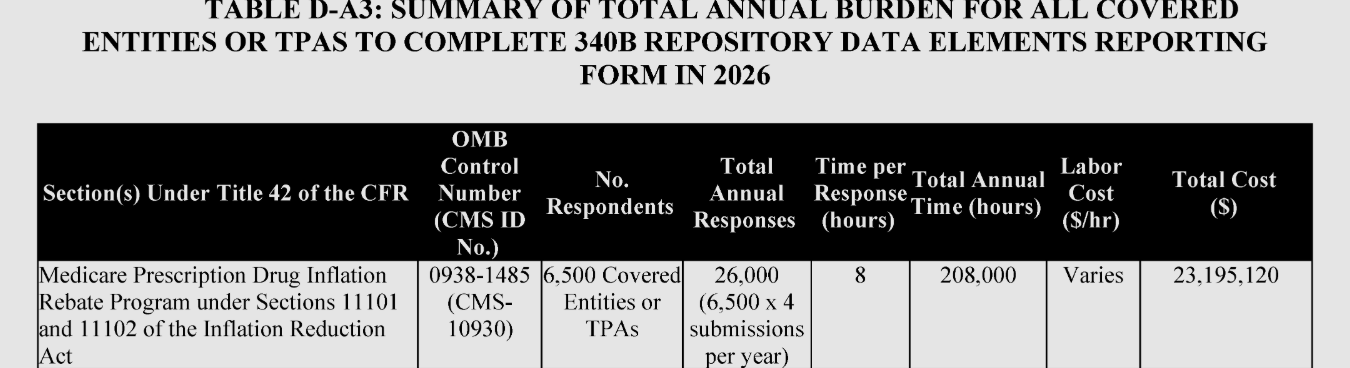
Within the broader PFS final rule, Section III.I establishes the framework through which 340B covered entities may begin submitting claims-level data for Medicare Part D drugs purchased under the 340B program. CMS will collect a limited set of data elements to test the functionality of the repository, evaluate data completeness, and assess the feasibility of matching submissions to Part D PDE records. CMS anticipates that approximately 6,500 covered entities or their contracted third-party administrators will choose to participate in 2026. Each quarterly submission is expected to require eight hours of work (six hours of technical data preparation and two hours of managerial review) resulting in an estimated 208,000 total burden hours and approximately $23.2 million in labor costs across 26,000 annual responses. From an administrative perspective, these estimates place the 340B repository among the most consequential paperwork components within the final rule, despite its limited immediate application.
Stakeholder feedback on this component reflected significant debate. Some commenters supported the testing period and emphasized the need for CMS and covered entities to establish reporting infrastructure before any future mandatory requirements are considered. Others argued that voluntary reporting would produce insufficient participation, limiting CMS’s ability to validate the repository’s usefulness and undermining preparation for the statutory requirement to exclude 340B units from inflation rebate calculations. Several commenters urged CMS to transition quickly toward mandatory reporting, whether immediately or beginning in 2027, while others highlighted operational constraints for small, rural, and resource-limited providers.
CMS finalized the repository largely as proposed. Reporting will remain voluntary for 2026, and the agency declined to outline a timeline for a transition to mandatory reporting but noted that it is actively evaluating options. CMS emphasized that the data submitted in 2026 will be used exclusively for usability testing and will not influence inflation rebate calculations. The agency also retained the certification requirement and clarified that covered entities remain responsible for accuracy even if submissions are made through a third-party administrator. Future expansion of the repository’s scope or data uses will require separate rulemaking.
TRACKING TRENDS
The creation of the 340B repository represents a noteworthy administrative development within a much larger and wide-ranging final rule. Although CMS has limited the 2026 reporting period to voluntary submissions, the structure established in this final rule signals a potential shift toward more formalized reporting in future years. The estimated 208,000 annual burden hours underscore the scale of the administrative activity involved, particularly for entities with limited staffing and system capacity. How many covered entities choose to participate in the voluntary period will likely influence CMS’s assessment of whether voluntary reporting can produce reliable and comprehensive data or whether mandatory reporting will ultimately be necessary.
TOTAL BURDENS
Since January 1, the federal government has published $700 billion in total regulatory net cost savings (with $74.1 billion in cost savings from finalized rules) and 65 million hours of net annual paperwork cuts (with 48.1 million hours coming from final rules).
 Policy Interns
You must be logged in to post a comment.