By: Conor O’Malley
America was shaken on October 5, 2011 by the death of Steve Jobs to pancreatic cancer. All one could see in the papers, television, blogs, twitters, facebook status’, and other media outlets was about his death. Without a doubt the world has lost a brilliant mind, however, I find the lack of coverage as to how he died to be substantially underplayed.
I, will be the first to admit, am biased on this subject, my mother was diagnosed with pancreatic cancer almost 5 years ago. Many famous people have died with or from pancreatic cancer including, Patrick Swayze, Joan Crawford, Michael Landon, Fred Gwynne, and Luciano Pavarotti are only to name a few. So then why do so few people know little to none about pancreatic cancer?
The American Cancer Society releases annual reports about the state of cancer throughout the country and has already released the one for this year. The statistics are interesting, albeit unfortunate to read, as all types of cancer are horrible and leave such a negative impact on too many people and their families.
The purpose of this blog it to show the lack of funding, research, and overall medical progress in the pancreatic cancer medical field. In an attempt to put the situation into perspective, I will be comparing pancreatic cancer to breast and colon cancer. I chose these because breast cancer are typically found in women where colon cancer is commonly found in men, while pancreatic cancer is common to both sexes.

The first statistics I would like to point out is the number of people diagnosed versus those who are, unfortunately, no longer with us. The graph to the left shows the comparison between breast, pancreatic, and colon cancer when it comes to this topic. Of the people diagnosed with breast cancer this year (232,620), only about 17% of those patients have died this year. Of colon cancer patients diagnosed (101,340), only 25% of them have died, while of the pancreatic cancer patients diagnosed this year (44,030) 85% have already died.
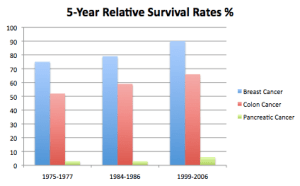
Another interesting study (shown right) done by the American Cancer Society, was a 5-year relative survival rate from 1975-1977, 1984-1986 and 1999-2006. Out of a 100% survival rate, I have made a graph that shows breast, colon, and pancreatic cancer survival rates during the respective times. From 1975 to 2006 the survival rate for breast cancer jumped from 75 to 90%, while the colon cancer survival rate rose from 52 to 66%. Pancreatic cancer, on the other hand, in a span of 31 years has grown from 3% to a 6% survival rate.
The lack of increase could be stemmed from a number of possibilities. A lack of money for research, lack of outreach, lack of “limelight”, or simply lack of interest. Where breast and colon cancer, affect more people, the crowd of supporters are much larger. It is possible that the pancreatic cancer community cannot build to the size of the breast and colon cancer community for two solid and logical reasons. One, breast and colon cancer, as previously stated, effect more people. Where this year only 44,030 people were diagnosed with pancreatic cancer, more than double were diagnosed with colon cancer, and more than five times were diagnosed with breast cancer. Secondly, pancreatic cancer kills its victims much more rapidly than that of breast and colon cancer patients, so they do not possess the long term support that other cancers have..
Dr. Michaela Banck, a medical oncologist at the Mayo Clinic said to a CNN reporter that “right now, pancreatic cancer is getting publicity, but it’s a neglected disease… It doesn’t draw the same attention as colon cancer and breast cancer. Activist groups raise small amounts of money, since it’s a rare disease… We don’t have enough money to make progress as fast as we’d like to.”
 Depending on the aggressiveness, and location of certain cancers, the survival percentage can vary. However, there are consistent signs among breast, colon, and pancreatic cancer that shows distant (or overgrown) cancerous tumors are the most dangerous where regional (medium sized area) is less dangerous, and a localized case is the most hopeful. Reflected in the graph to the left, one can compare the corresponding cancers to their survival rates. Where breast cancer is 98% curable if localized, and colon is 90% when local, pancreatic cancer has a survival percentage of only 23%. The statistics only get worse, is the pancreatic cancer spreads regionally or to distant, the survival percentage goes from 23% to 9% and then 2%. Not to mention to current statistic for surviving pancreatic cancer patient to make it past 5 years after diagnosis is about 7-10%.
So what can the pancreatic community do to raise awareness? The PanCan organization (pancan.org) provides information on the cancer, ways to donate, or participate in events. One can write to their representatives asking for them to allocate more funds for research towards a medical breakthroughs. Also visit the American Cancer Society’s website http://www.cancer.org.
 Policy Interns
You must be logged in to post a comment.