Executive Summary
- The U.S. government and corporations do not release data on the price of submarine cable faults, raising concerns for national preparedness.
- Fiber-optic submarine cable faults cost the U.S. an estimated $22-$90 million annually. Power submarine cable faults cost the U.S. $12-$116 million to repair annually. The indirect costs of repair can range from $1.5-$24 million per repair.
- This lack of transparency indicates that there is an urgent need for greater investment in data collection and strategic attention to safeguard this critical infrastructure.
Introduction
The buffer while you are binge-watching Netflix may be due to the disruption of submarine cables, which lie on the bottom of the sea floor. Submarine cables form the backbone of global digital and energy infrastructure, carrying 95% of international data traffic and supporting offshore energy operations. These cables are typically owned by private companies (e.g., Google, Amazon, & Microsoft). These cables fall into two categories: fiber-optic cables, which transmit internet data, and power cables (underwater transmission cables), which carry high-voltage electricity beneath the sea. While both differ in function, both are susceptible to damage caused by anchor strikes, fishing activity, and natural disasters.
According to TeleGeography, there are around 600 active fiber-optic submarine cables globally, 93 of which are connected to the United States, while there are only 7 main power submarine cables in the U.S. However, there is currently no publicly available data on how much the U.S. government and corporations spend to repair these cables when there are faults. To address this gap, this analysis focuses on both the types of cables and the causes of faults.
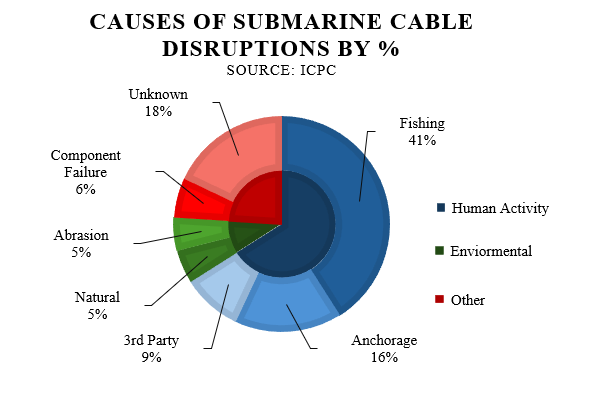
As shown in the figure above, the reasons for submarine cable damage by the percentage of probability are:
- Fishing and Anchoring (57%): Often accidental but can shear cables and require urgent repairs. Typical damage is moderate, causing hours to days of disruption.
- Deliberate Sabotage (9%): These rare but severe events can destroy entire cable segments, with outages lasting weeks or months.
- Natural Events (5%): Earthquakes, currents, and landslides cause isolated but hard-to-reach damage.
- Shoreline Erosion (5%) and Component Failure (6%): Usually moderate in scope and quicker to repair.
- Unknown Causes (18%): These vary in impact, sometimes concealing deeper geopolitical or technical vulnerabilities.
Cost Estimates of Fiber-Optic Submarine Cables
The United States has around a 15 percent share of the world’s total amount of fiber optic submarine cables. Damage to submarine cables is not uncommon, with an average of 150 to 200 faults occurring globally each year and requiring about three cable repairs per week, according to the International Cable Protection Committee (ICPC). On average, this means that the United States has 22–30 faults occurring per year. These faults are then categorized by cause based on industry percentages. The cost of replacing a sea cable due to anchoring varies, but repairs can average between a low estimate of $1 million and a high estimate of $3 million. Multiplying the number of faults per cause by the respective average costs and summing across categories produces a total estimated annual direct repair cost range. As shown in the two tables below, the direct costs from fiber-optic submarine cable damage to the U.S. each year are estimated to be between $22 million and $90 million.
Low Estimate of Costs of Faults in Fiber-Optic Submarine Cables
| Causes | % Share | Faults per Year | Avg Cost / Fault | Total Cost |
| Fishing/Anchoring | 57% | 13 | $1 million | $13 million |
| Deliberate Sabotage | 9% | 2 | $1 million | $2 million |
| Natural Events | 5% | 1 | $1 million | $1 million |
| Shoreline Erosion | 5% | 1 | $1 million | $1 million |
| Component Failure | 6% | 1 | $1 million | $1 million |
| Unknown | 18% | 4 | $1 million | $4 million |
| Total | 100% | 22 | $6 million | $22 million |
High Estimates of Costs in Fiber Optic Submarine Cables
| Causes | % Share | Faults per Year | Avg Cost / Fault | Total Cost |
| Fishing/Anchoring | 57% | 17 | $3 million | $51 million |
| Deliberate Sabotage | 9% | 3 | $3 million | $9 million |
| Natural Events | 5% | 1.5 | $3 million | $4.5 million |
| Shoreline Erosion | 5% | 1.5 | $3 million | $4.5 million |
| Component Failure | 6% | 2 | $3 million | $6 million |
| Unknown | 18% | 5 | $3 million | $15 million |
| Total | 100% | 30 | $80 million | $90 million |
Cost Estimates of Power Submarine Cables
This section isolates the risk and cost of power submarine cable failures in the United States, using industry-based fault rates and actual cable infrastructure data to estimate the frequency and potential monetary impact of such faults. There is a total of 7 power submarine cables in the U.S. (Cross-South Cable, Neptune Cable, Y-49 Cable, Y-50 Cable, Northport-Norwalk Cable, Trans Bay Cable, and Hudson Transmission Project), totaling a length of 330 kilometers. According to a 2019 study done by the University of Strathclyde, the average rate of power cable failure is approximately 0.003 failures/km/year for European wind farms. Using this rate and the length of the cords (330 km * 0.003 faults per year = 0.99 faults per year), a fault occurs once per year. This additional cost can range from $12 million to $116 million for each fault.

Estimates of Indirect Costs of Economic Damage
The indirect costs of submarine cable disruptions extend far beyond physical repair, impacting economic activity, energy markets, digital infrastructure, and national security. Financial markets can lose millions per minute due to latency or outages, stalling business operations globally. National security is also at stake, as undersea cables carry sensitive defense and intelligence communications vulnerable to sabotage or interception. Companies may also face insurance claims and reputational damage. In the energy sector, power submarine cables tied to offshore wind or cross-border grids can trigger price spikes and grid instability when compromised.
One estimate suggests that undersea cables contributed $649 billion to the U.S. economy in 2019, equating to about 3% of U.S. GDP. The International Cable Protection Committee (ICPC) legal advisor estimates that interruptions of underwater fiber-optics communications systems have an indirect financial impact exceeding $1.5 million per hour. Submarine cable repair can take up to 16 hours. This means the indirect costs of repair can range from $1.5 million to $24 million per repair.
Conclusion
The greatest concern is not the financial cost of submarine cable disruptions, but the absence of transparency around how the United States is preparing for them. There is no centralized data or a clear national strategy, and no public accountability for how much is being invested to repair or protect this critical infrastructure. This opacity hinders coordination, risk assessment, and long-term planning. While damage is one way these cables can be disturbed, these cables can also be tapped. Raising the question of the need for protection of these cables due to national security risks.
As these cables become more essential to economic stability and energy resilience, the current lack of oversight is increasingly problematic. Greater federal investment in data collection and a coordinated national framework is urgently needed to ensure these systems are maintained and protected properly.
 Policy Interns
You must be logged in to post a comment.