Executive Summary
- Due to the number of regulations imposed, the regulatory burden on the education and healthcare sectors has increased over the past few decades. This is leading to school and hospital administrative roles increasing significantly faster than more traditional roles such as physicians and teachers, which projections say will continue over the next decade.
- This increase in administration uses funding that would otherwise go to teachers and physicians in addition to delaying patient care and taking valuable time from consumers, causing more stress.
- By reforming regulatory policy and cutting administrative costs, we could use resources more efficiently and boost productivity, achieving similar results while using fewer resources and retaining extra funding for miscellaneous costs in each sector to increase affordability.
Introduction
During the past few decades, the number of administrative workers hired has increased exponentially, while the number of teachers and physicians hired has also risen, albeit much more slowly. Data show that, from 1949 to 2022, the number of administrative roles in schools increased 370.18 percent, while the number of teachers only increased 253.42 percent. The healthcare sector shows a similar pattern, with administrative roles having increased almost 5000 percent and physicians having increased by less than 500 percent since 1970.
This increase in administration is correlated with the amount of regulatory laws placed on both of these industries. The Medical Group Management Association’s (MGMA) 2026 Burden Report found that Medicare reporting requirements and federal mandates divert resources away from patient care, creating a greater need for administrators to handle these additional tasks. Forty percent of practices reported that they had hired multiple administrative roles per physician in order to keep up with these requirements. This diverts attention from patient care, leading to reduced efficiency and increased physician burnout.
Schools have a similar issue, as a growing administrative burden causes an increase in both administrative roles and the workload for teachers. While administrators are able to manage certain tasks, teachers are often left with classroom responsibilities such as attendance, progress reports, responding to parent emails, and more. Though more administrators are hired, they are typically not able to manage these duties. This leads to greater expenses for schools for very similar results, with teachers remaining responsible for most of the burden.
By reforming these regulatory laws, administrative bloat in healthcare, education, and other affected sectors could be reduced. This would allow funding for these roles to go elsewhere, reducing lower prices and creating a more efficient economy overall.
The Numbers
In the past few decades, there has been a significant shift in the number of administrative roles in comparison to their more traditional counterparts. From 2000-2019, the number of administrators hired was over ten times that of the number of teachers hired, with an even more drastic difference in the healthcare industry. 
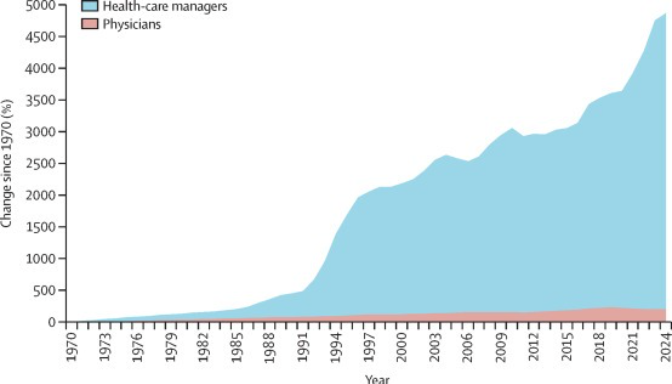
The healthcare industry is also expected to continue at this current rate, with the number of healthcare administrator roles projected to increase at 23 percent compared to the expected 3 percent rate of increase of physicians and surgeons. This increase in hiring in administrative roles will continue to divert resources that other could be used to meaningfully increasing quality of care.
The Issue
For many reasons, this large increase in administrative roles represents a problem in both industries. It generally makes processes less efficient and spreads funding more thinly, in addition to taking time away from both providers and consumers. Though it is important to remember that administrative bloat has different effects on each sector, these general effects are maintained across most industries with this same problem, costing the general population additional time and money.
Within the healthcare industry, this can be seen in a few different ways. Firstly, a 2021 study found that at least 73.2 percent of patients spent extra time on administrative tasks such as gathering information and giving it to other providers, with one in four reporting delayed or issues with care due to this. The same study reported that one third of patients who had issues with billing or prior authorization received delayed or missed care. Lastly, it was found that those spending more time on the phone with their insurers reported higher stress and burnout, with an estimated cost of $26.4 billion per year due to work absences and $95.6 billion lost in productivity. One analysis estimated that workers spent the equivalent of $21.6 billion in time working with administrative tasks each year.
While this causes patients much more trouble, it also decreases efficiency from the workers. Studies show that roughly 25-40 percent of physicians’ time is spent on patients, while the majority of the rest of the time is dedicated to administrative tasks. Electronic health records (EHRs) alone take up roughly 30 percent of physicians’ time, though that time is spent navigating the platform or recording previously taken notes electronically.
During the coronavirus epidemic, this regulatory issue became so pressing that the federal government issued a waiver on many Center for Medicare and Medicaid Services (CMS) regulatory requirements, as there was a much larger volume of patients in need of treatment. This waiver allowed greater hospital capacity, increased the workforce, and permitted more patients to be seen through telehealth appointments. The original regulations limited the scope and effectiveness of the healthcare industry, and healthcare professionals generally agreed that the waiver increased efficiency. This demonstrates that regulations truly are a sticking point in healthcare and that the large number of them currently active play a part in reducing efficiency.
In addition to the negative effects of this increase in administrative roles in healthcare, it has also greatly changed the education sector. From 2000-2022, administrative roles have increased by 87.6 percent, while teachers have only increased by 8.7 percent and students by 7.6 percent. Around one fourth of total school budgets are now spent on administrators. This money could otherwise be spent on more teachers, specialized aids, additional programs, more materials, or other factors which more concretely benefit schools.
Since 2004, as the number of administrative roles has continued to increase, inflation-adjusted teacher salaries have dropped, leading to an ever-increasing pay gap between teachers and similarly educated professions. While teacher wages may not seem directly valuable to the consumer, they are a primary cause of the teacher shortage during the last few decades. In order to attract and retain teachers, wages must remain close to those of similarly educated individuals. As salaries drop, it becomes more difficult to maintain and improve the schooling system overall.
The Solution
Though administrative bloat has pervaded the healthcare and education sectors for decades, the solution is more simple than appears. By revising regulations, Congress can make these sectors much more efficient and increase savings.
In schools, there are many paths that could be taken to improve this increase in administration. Some of these include the standardization of student records, consolidation of reporting requirements to different states’ education departments, and reducing approvals necessary for lower risk decisions. These solutions would simplify many administrative tasks, increasing efficiency and reducing the need for excessive administrative roles.
When considering healthcare, there are also multiple solutions. Similarly, standardizing reporting requirements across insurance programs would allow for more productivity, as would simplifying the prior authorization process and allowing electronic submission for required regulatory and reimbursement processes. According to a survey from the Medical Group Management Association (MGMA), 79 percent of responding practices reported negative impacts from Medicare Advantage programs alone. This illustrates that there are many ways regulatory reform could improve efficiency and productivity in the healthcare sector.
Conclusion
Though many sectors have been plagued by administrative bloat, it continues to pose an issue in many of them, there are many possible solutions to this problem. This issue has caused a significant decrease in productivity and efficiency, and demonstrates that not all administrative roles are necessary. Through regulatory reform, some of this could be counteracted and industries could both save money and become more productive, leading to more efficient businesses and a better experience for both producers and consumers.


You must be logged in to post a comment.