Executive Summary
- Spirit Airlines recently shut down, prompting questioning of whether the airline market would benefit from greater government regulation.
- Airline regulations are often ineffective due to many factors unique to the market that are not always heavily weighted.
- Reversion to increased regulation could be harmful to consumers, leading to increased prices and reduced options.
Introduction
On May 2, 2026, Spirit Airlines declared that it would shut down, stating that it would begin winding down operations effective immediately. This sparked surprise and curiosity in many consumers, causing many to question if the market would benefit from increased government regulations and even urge intervention. However, regulations have historically been ineffective and caused more detriment than benefit.
Factors in Regulation
When making decisions regarding airline regulations, particularly merger enforcements, the DOT focuses firstly on factors such as consumer welfare, market concentration, and barriers to entry. While these are incredibly important factors, the Department of Justice has also stated that they do “not have a merger policy that is specific to the airline business”. While it makes sense to have consistent goals across markets, such as consumer welfare, this policy could cause greater difficulty when making decisions about the airline market due to its unique characteristics.
Unlike competitors in many other markets, individual airlines have different business models and motivations to act. Since the airline industry has such a narrow profit margin, with the expected profit per customer at $4.50 in 2026, various precise profit maximization strategies emerge from different carriers. When predicting the market direction, it follows that they must be looked at through different lenses to determine their most probable course of action.
The primary difference between different airlines is that of their business models. Some airline, such as United, American, and Delta, are global network carriers (GNCs). These airlines have much larger scopes and tend to have higher ticket prices which include things such as meals, seat selection, and extra bags. On the other hand, airlines such as Frontier Airlines and Ryanair operate as ultra low-cost carriers (ULCCS), charging a much lower price for tickets with ancillary fees for other benefits. In between these, there are also low-cost carriers (LCCs), which provide a middle ground. Tickets may be slightly more expensive than ULCCs but likely include certain benefits that they do not have.
Another key difference are the routes that each airline chooses to take. There are generally two strategies: the hub and spoke model and the point-to-point model. Some airlines, often GNCs, employ the hub and spoke method, choosing to have one airport serve as a base of operations. This airport employs the majority of the staff, and most of the airline’s flights are routed through it. Point-to-point airlines tend to be LCCs or ULCCs, and are often regional, focusing primarily on heavily trafficked city-to-city pairs.
Even within these models, airlines function differently. Southwest, for example, is an LCC, but covers a much larger region by scheduling routes primarily from minor airports within major cities. This allows it to spend a similar amount of money while reaching more locations, though it has other tradeoffs. JetBlue also operates uniquely, as it is able to maintain lower-priced tickets with high-quality flight experiences by selling five different classes of tickets. Each individual airline functions vastly differently and must be treated as such.
The Effect of Deregulation
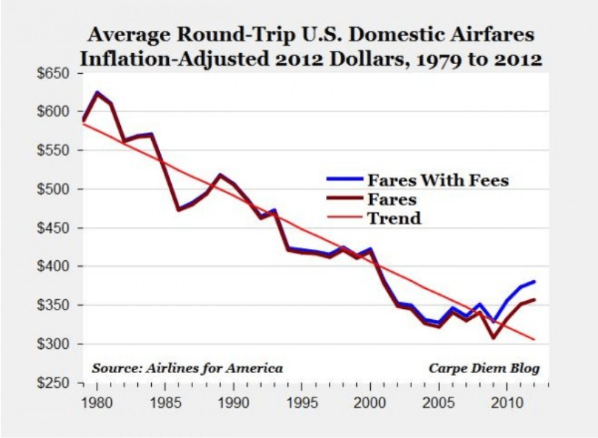
Though regulatory bodies know about these distinctions, it is rare that they are heavily considered when deciding regulations, as factors such as barriers to entry, consumer welfare, and market concentration often hold the most weight. Thus, regulation is often more harmful than beneficial. Following the Deregulation Act of 1978, dozens of new airlines formed, old airlines expanded, and innovation skyrocketed. Airlines developed new business models and started competing for lower prices, leading to consistently decreasing prices for air travel in the United States.
*Source: American Enterprise Institute
After deregulation occurred, there was an immediate downward trend in pricing, showing that regulations that were formerly in place were detrimental to consumers. This pattern has continued to hold in recent years, with the fares of Q1 2025 being the most affordable on the record, excluding prices from 2021 following the COVID-19 pandemic.
*Source: International Civil Aviation Organization
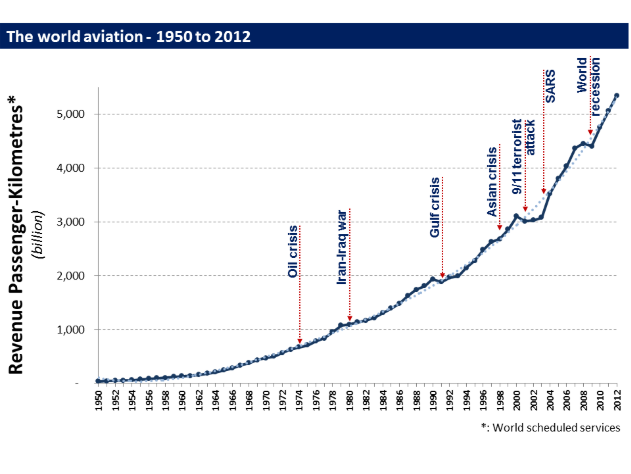
Since the Deregulation Act of 1978, passenger traffic has also increased more quickly, with a shift in slope visible just before the Iran-Iraq War, thus also increasing market competition. This allowed airlines to begin competing on new factors such as prices and routes, seeking innovative methods to attract the most customers and expand. Government regulation formerly put restrictions on these factors, leading to a renaissance for the airline market in 1978, which underscored how limiting previous regulations had been.
*Source: Airlines for America
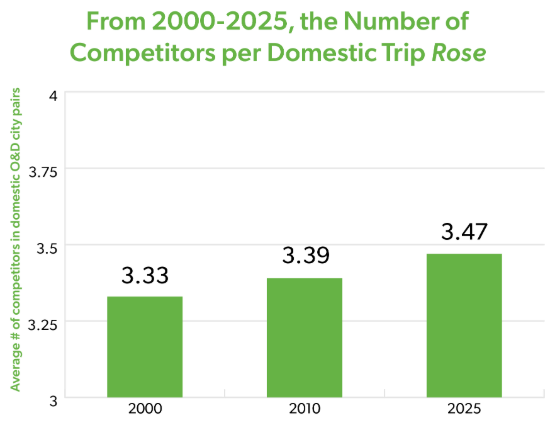
Even domestically, it is clear that the airline industry is thriving despite Spirit’s recent shutdown. While this worried some consumers, the bankruptcy had no significant effect on competition within the United States, allowing airlines to continue competing for the best prices and lowest fare. It would be inadvisable to introduce new airline regulations, as that would risk the steady growth of competition the US market has sustained for the last three decades.
Conclusion
Since airline policy is especially challenging to regulate due to the unique aspects of the market, the market often functions most effectively with no regulation from the government. This was shown after the Deregulation Act of 1978, after which airline prices decreased, and consumers increased. Amidst calls for a return to heavier airline regulation, it is important to remember the true effects this legislation had in the past. Commercial aviation drives 5% of the United States’s GDP, the equivalent of trillions of dollars, and transports millions of people every day. Airlines are crucial to the US economy, and any proposed regulations affecting them must be carefully considered.


You must be logged in to post a comment.