Executive Summary Introduction Occupational licensing reform has gained traction at both state and federal levels in recent years, geared towards eradicating unnecessary barriers that restrict employment opportunities. Laws regarding licensure cover nearly one-third of the U.S. workforce, creating barriers to entry rather than a safeguard for the public interest. Although licensing raises the wages … Continue reading
Tag Archives: Economy
Impact of Retail Electricity Deregulation on Consumer Prices: A Difference-in-Difference Approach
Executive Summary Introduction Electricity has become the most fundamental commodity in the United States. Its growing influence underpins nearly every major industry. It powers homes, infrastructure, and manufacturing. Innovation and technological development for the entire economy depends on efficient and reliable energy transmission. Utilities markets in the U.S. have historically been viewed as natural monopolies. … Continue reading
How Biden Helped to Create Trump’s Unilateral Trade Policy Process
Executive Summary Introduction Throughout his time in office, President Biden was a persistent advocate of innovative executive branch tactics to restrict trade volumes and capital flows in and out of the United States. While Biden did not engage in the brinkmanship negotiation strategies President Trump has used over the past month, he did use the … Continue reading
The Twin Deficit Hypothesis: An Analysis of the U.S.
Executive Summary Introduction Government deficits and the trade balance have seemed to fluctuate in tandem over time. This has given rise to theories connecting the two deficits to explain their relationship. U.S. fiscal deficits have ballooned in recent years, bringing renewed attention to the twin deficit hypothesis (TDH) and applying it to advanced economies. Modeling … Continue reading
The State of State Backed Insurance
Executive Summary Introduction The purpose of insurance is to mitigate the risks of a probable loss for consumers. Some consumers are inherently riskier to insure than others simply based off where they choose to live. This causes many property and casualty (P&C) insurers to demand higher rates or forego plans completely. In the instance a … Continue reading
Playing Chicken with a Coyote: Why the U.S. has Less Leverage over Mexico than Trump Believes
Executive Summary Introduction In the 1955 movie A Rebel Without a Cause, James Dean introduced Americans to the game of “chicken,” wherein two cars accelerate towards each other until one swerves. The swerving car’s driver is labeled the “chicken,” and the steady driver wins. Eighty years later, the game of chicken is not just a … Continue reading
Are the Elderly Hurt More by Inflation? A Glimpse Inside the Housing Market
Executive Summary Introduction The Consumer Price Index (CPI) is a measure of the change in prices in a typical consumers basket. The elderly tend to consume a different bundle of goods compared to the typical consumer. The Bureau of Labor Statistics (BLS) has introduced an experimental CPI, labeled CPI-E, to determine the relative importance of bundles for … Continue reading
BRICS and Currency Diversification Challenge the Dollar
Executive Summary Introduction Since the inception of global trade, there has always been a dominant, trusted currency used to facilitate transactions between parties to avoid the double coincidence of wants associated with bartering. The U.S. dollar (USD) has been the premiere global currency since the Bretton Woods Agreement of 1944 where it was crowned in … Continue reading
As unaffordable housing swells, its causes (and proposed solutions) should be considered
The nation undoubtedly faces an affordable housing problem, one that can be understood through the economic lens of housing supply-and-demand. Since the Great Recession, mortgage rates have remained low but at the expense of overall housing costs, with prices of the average American home soaring to $316,000 in June of 2019. A study by Freddie Mac attributes the rise … Continue reading
From the Past to the Present: U.S. Protectionism
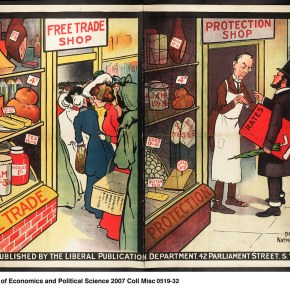
Since assuming office, President Trump has shaken the foundation of global trade with his use of tariffs. Tariffs, in simple terms, are taxes levied on imported goods. Trump’s intentions, in line with his America First campaign promise, are to boost the domestic manufacturing industry, reduce the U.S. trade deficit, and to leverage foreign countries into … Continue reading
You must be logged in to post a comment.