Executive Summary
- Last week, the World Trade Organization (WTO) concluded its 14th Ministerial Conference (MC14) to plan the institution’s agenda for the next two years.
- Reform was front-of-mind for all members, including the United States; its vision for the WTO focuses on constraining developing member privileges, ensuring leeway for security-based trade measures, and making member commitments more flexible in general, differing markedly from other proposals like that of China.
- Though MC14 was largely a failure for American-led reform, the United States must continue fighting to mold the institution, particularly through the use of plurilaterals (agreements between some—but not all—WTO members).
Introduction
On Monday, March 30th, the MC14 meeting of WTO members in Yaoundé, Cameroon, came to an end. Occurring every two years, MCs allow member states to voice their concerns, negotiate new agreements under the WTO, and guide the organization’s priorities until the next MC. Contextualized by a broken dispute settlement mechanism and inflamed international protectionism, MC14 was one of the highest-stakes assemblies in the history of the WTO.
Consequently, the United States entered MC14 with major ambitions. These included devising criteria to define development status among members, deeming trade measures taken for self-declared essential security purposes as ineligible for WTO judicial review, beginning discussions on the most-favored-nation (MFN) principle’s drawbacks, and an indefinite extension of the ban on digital customs taxes.
Relatively little came from the days of deliberations. Besides the circulation of a draft reform statement and 165 out of 166 members approving the Investment Facilitation for Development Agreement, multilateral efforts stalled. Washington’s chief objective, making the digital customs tax moratorium permanent, ended in failure as Brazil and Turkey stood opposed. Though plurilateral agreements saw promising use, with 66 members negotiating their own deal to extend the moratorium, MC14’s pace of change was seemingly far slower than what was warranted.
Though members have pledged to continue the progress made in Cameroon, American policymakers have expressed biting displeasure with the organization after a cumbersome four days. But a WTO without the world’s largest economy would be far less effective in policy coordination, and the benefits of a fair, functional WTO make it within Washington’s interest to remain a member. The United States must continue pushing to reform the WTO according to its vision, or face a detrimental global trading order. Plurilateral agreements present an opportunity.
The WTO: A Brief History
The WTO was formed in 1995 as the institutionalized successor to the General Agreement on Tariffs and Trade (GATT). Operating with the mission of trade liberalization, deliberation, and negotiation, the WTO has five core tenets: MFN, national treatment (equal treatment of traded goods once inside national borders), freer and more competitive trade, development, and predictability.
Structurally, the WTO encompasses several components. MCs set the organization’s agenda and priorities until the next MC, guiding WTO resource allocation. The General Council assembles throughout the year at WTO headquarters in Geneva, Switzerland, to carry out what MCs order, oversee agreement implementation, and—when operational—execute the dispute resolution mechanism (DSM). Since 2019, that system has been debilitated by a lack of appointments to the Appellate Body (AB), or the functional court that hears appeals to DSM panel reports (decisions). Below the General Council, there are many committees and subcommittees performing research and tracking global trade policy.
As of 2026, the WTO is facing an increasingly hostile trade environment. Free trade is being lambasted by leaders across the world, while the unanimous votes required for the body to adopt new agreements have immobilized adaptation to this new reality. Naturally, the submitted solutions to WTO issues for MC14 vary wildly, and it is through examining some of the most important countries’ ideas that a clearer plan for a revised WTO can be formulated.
Reform Vision #1: The United States
Washington published a six-point plan for a WTO revamp shortly before MC14’s inauguration. Some proposals were less radical. For instance, the official document begins by advocating for incentivizing notification, or the process of members keeping the WTO updated on their trade-distorting policies (ex. subsidies, price controls) for the awareness of other members. There is also a plea to make the WTO Secretariat less biased by giving clearer directives and mandating more frequent reporting on the use of member-contributed funds. Rounding out the less upheaving category, the United States Trade Representative (USTR) urges the WTO and members to embrace plurilateral agreements as multilateral votes have proven strenuous. This would mean wielding plurilateral deals as experiments preceding their adoption by all members or installing other means of easing plurilateral evolution into multilateral rules. Though such a reform would weaken the WTO’s fervent multilateral foundations, it would also ensure sustained relevance as states increasingly turn to regional and bilateral trade agreements.
On the more extreme side, USTR disavows the MFN principle altogether, calls for serious changes to special and differential treatment (SDT; flexibility in the implementation of WTO agreements granted to self-identified “developing” members), and more allowances for trade policies enacted for reasons of essential security. Unconditional MFN and SDT are both posed as being exploitative, the former for its lack of reciprocity and manipulation by non-market economies, the latter for undeserving economies taking advantage of developing status benefits. In matters of essential security, USTR supports total national independence when asserting a trade policy as necessary for member defense, stating such declarations should be excluded from all WTO judicial consideration. That last recommendation seems to be an extension to the WTO of the more arbitrary tariff policy the Trump Administration has pursued domestically. As a result, it is the reform whose utility should be most questioned.
Reform Vision #2: The European Union
In contrast to the United States, the EU released its reform recommendation organized around three principles: predictability, fairness, and flexibility. Under predictability—the least ambitious tenet—Brussels backs incentivizing the notification system and making it more efficient. This also includes making the AB functional. Under fairness, a less harsh skepticism of unconditional MFN is laid out. The EU desires a review of how reciprocity figures into the system, but not its complete elimination.
Additionally, defining “developing” status, qualifying the application of SDT, and forging a mechanism for opening the markets of growing yet disproportionately commercially closed members are mentioned as well. Part of this includes incorporating full abolitions of the worst distorting industrial policies into the Agreement on Subsidies and Countervailing Measures (ASCM). Finally, under flexibility, the EU fixates on WTO voting practices, namely reforming the “single-undertaking” logic (all components of a trade agreement must indivisibly pass for adoption by the body), instituting measures to limit the ability of single members to block popular proposals, and exploring options like the GATT’s variable geometry voting procedures. Such a shift would entail the sequential adoption of WTO agreements by willing and able members.
Reform Vision #3: Least-Developed Countries (LDCs)
Following designations made by the United Nations, the LDC group comprises the most underdeveloped states of Africa, Asia, and the Americas. Subsequently, their reform proposals are premised on the need for unique treatment among developing members. SDT provisions are defended as necessary, and any associated problems with them are claimed to be from member misuse. There is a call for long-term technical aid for the LDCs to meet notification system responsibilities. Support for a functioning AB is offered. Plurilaterals are cautiously embraced if they enhance the multilateral foundations of the WTO, and the United States’ essential security concerns are ambiguously recognized. Wrapping up their vision, the LDC group requests to be, at a minimum, included in all reform debates henceforth.
Reform Vision #4: China
Lastly, Beijing’s reform agenda is the most compact at only two pages, and resolutely in favor of preserving the multilateral trade regime. SDT in its current form is praised, MFN is supported, and China comes out in favor of a working AB. Security exemptions are decried as harming the foundations of free trade, while plurilaterals are favorably presented and said to need deeper utilization. Like the EU, reform to the ASCM is floated, though this is less fleshed out and is then qualified by differentiating obligations by member development status.
Analysis: Plurilateralism Ascendant
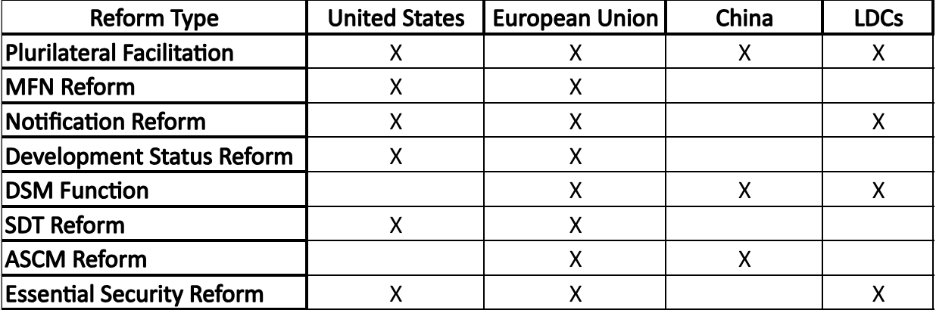
Figure 1: Broad Agreements on WTO Reform Ahead of MC14, “X” for Support
Source: World Trade Organization
As Figure 1 displays, one reform unites all four proposals: facilitating more plurilateral agreements. It seems that unanimity in adding or changing all WTO rules is perceived as impractical, and whether a plurilateral is conceived of as an interim agreement, variable geometry, or, as the LDCs and China mandate, never damaging multilateralism, no party is against this type of agreement. The last half-decade of WTO struggles has sent a message.
In every other area, however, Washington’s recommendations are not commonly shared. The United States and EU agree on many issues, with Washington typically taking a more resolute stand in favor of or against a given proposal. Both members want to galvanize notification, define “development” rather than continue with self-declarations, qualify the application of SDT to ensure use only when necessary, and implicitly support the folding of reciprocity into MFN. That said, on essential security, the EU favors less discretion for members than the United States. Still, there is a striking overlap between the states’ proposals.
Meanwhile, Washington has less agreement with the LDC group and China. Whereas the United States is pushing for a plurilateral-focused, flexible WTO, the LDCs and Beijing are attempting to better preserve the organization’s founding ethos of multilateralism and development. Though there is partial common ground, like on some essential security reform with the LDCs, “developing” members like the LDCs and China oppose much of USTR’s agenda. With that context, and with 2/3 of WTO members self-describing as “developing,” the failure of American MC14 proposals to gain significant traction was predictable.
Yet, that outnumbering can be circumvented by the one invariably supported proposal: plurilateral initiatives. If Washington desires to see its measures adopted, it should harness plurilaterals to the fullest extent possible. This could be in adopting a definition of “developing” with a group of cooperative members, maneuvering an agreement on essential security exclusivity, or acting against non-notifying members with no excuse of capacity limitation. EU countries, the UK, and Japan, for example, may be motivated to work with the United States in the aforementioned areas that appeal to non-“developing” members.
Conclusions
The expiration of the moratorium on digital customs duties and the lack of meaningful discussion of deeper American WTO dissensions can be construed as ending the Trump Administration’s chances to play a leading role in the organization. But, as the broken-down proposals for reform indicate, a WTO without an active United States means a WTO led by members prioritizing development-centered free trade. Instead of losing hope in the possibility of reforming some of the WTO’s most excessive qualities, the United States can work its objectives into the body through plurilateral routes. It may not be a complete refashioning of the system, but regionally tailored prosperity is better than being completely cut out of international growth.
 Policy Interns
You must be logged in to post a comment.