Executive Summary
- Washington State, California, and Québec are merging their carbon markets by 2027 into one system, sharing a single carbon price and joint auctions. The shared program will cover roughly 75 percent of the emissions of two U.S. states and a Canadian province.
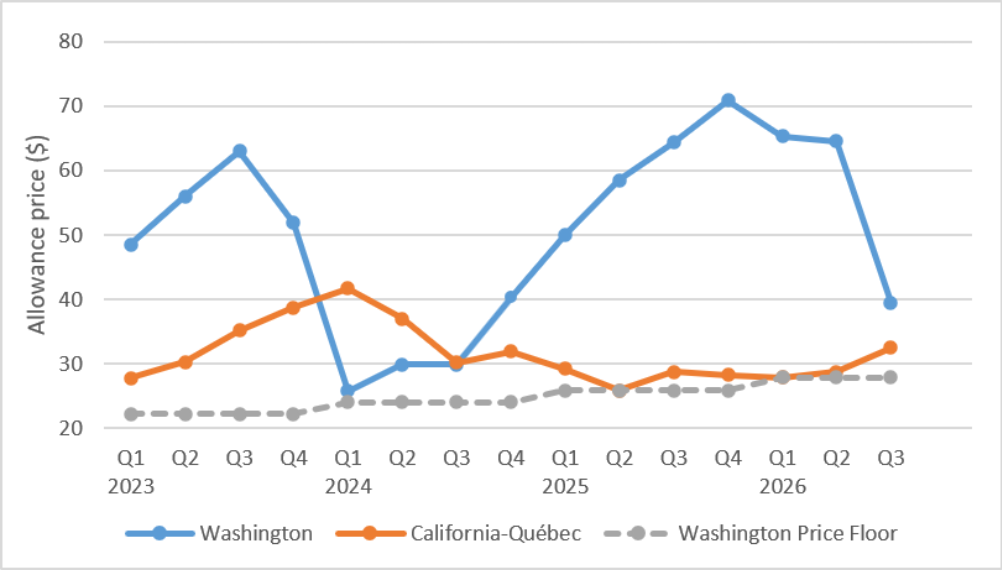
- Washington’s carbon price has surpassed California-Québec’s across most of its cap-and-trade’s history. Linkage gives Washington access to a much bigger carbon credit market, which should narrow the price gap.
- Washington’s carbon price is likely to fall after linkage, converging somewhere between its pre-linkage level and California-Québec’s. That decline may shrink auction revenue for the state, which has raised $4.3 billion since 2023 for clean infrastructure, tribal, and community health programs.
Introduction
On June 25, 2026, officials from Washington, California, and Québec signed an agreement to merge their cap-and-trade systems. Once linkage takes effect, which is expected in 2027, the shared carbon market will cover roughly 75 percent of greenhouse gas emissions of two large U.S. states and one Canadian province. A covered business in Washington could use an allowance issued in Québec. Jurisdictions would hold joint auctions and share a single carbon price. This insight explains how these subnational carbon markets work, why Washington’s carbon price has historically been higher than California’s and Québec’s, and what the linkage will mean for Washington.
How Does a Cap-and-Trade System Work?
Cap-and-trade reduces pollution by setting an overall annual emissions limit (cap) and lets the market determine the cost of meeting it. Governments issue allowances, generally representing one metric ton of emissions, and covered businesses must purchase and surrender enough of them to cover all emissions. Businesses can buy allowances at auction or trade them with other participants. Unlike a carbon tax, which sets the price per unit of emissions, cap-and-trade sets the total emissions limit for all the covered sectors in the economy.
In all three programs, any facility emitting at least 25,000 metric tons of CO₂-equivalent a year is covered. As the cap declines, fewer allowances are available. This leads to a higher carbon allowance price, which gives businesses a stronger incentive to reduce emissions. Businesses that can reduce emissions at relatively low cost can do so and sell unused allowances to businesses facing higher reduction costs.
Three Programs: Overview
California pioneered a multi-sector carbon cap-and-trade system in the US, beginning operation in 2012. The program is extended through 2045, and it helped the state reach its 2020 climate target six years earlier.
Québec launched the program in 2013 and linked it with California’s in 2014, becoming the first carbon market shared by sub-national governments across borders. This linkage, nevertheless, was not permanent, as the Canadian province of Ontario joined the system in 2018, and its new premier withdrew from it six months later.
Washington began trading carbon allowances in 2023 under a 2021 law that directed the state toward linkage with California and Québec from the very beginning. The program was politically challenged very soon: Initiative 2117, a statewide ballot measure that would have let Washington voters repeal the entire cap-and-invest program, appeared on the November 2024 ballot. While the measure was pending, carbon prices in the state collapsed to $25.76 from $51.89, ultimately recovering after the voters rejected the proposal.
Table 1. Washington, California, and Québec Carbon Markets
| Washington | California | Québec | |
| Program launched | 2023 | 2012 | 2013 |
| GHG emissions covered | ~70% of state’s GHG emissions (2022) | ~80% of state’s GHG emissions (2026) | ~80% of province’s GHG emissions (2023) |
| Covered entities | Power generation, fuel distributors, gas suppliers, industrial, and mining >25,000 tCO₂e (96 entities) | Same, plus agriculture and forestry fuel (~400 facilities) | Same, plus agriculture and forestry fuel (125 entities) |
| Latest auction price (USD) | $39.50 | $32.48 | $32.48 |
| Revenue to date | $4.3B since 2023 | $34.5B since 2012 | $7.85B since 2013 |
| Use of revenue | Clean transportation, community health | Energy bill credits, environmental projects | Household energy bills, green programs |
Sources: Washington Department of Ecology; California Air Resources Board; Ministère de l’Environnement du Québec; International Carbon Action Partnership, (2026)
What Factors Drove the Linkage
The linkage would make allowances interchangeable across Washington, California, and Québec, and they would share a single carbon allowance price. A larger market gives businesses more ways to meet compliance obligations and reduces Washington’s reliance on its relatively small pool of buyers and sellers, which is one reason Washington was pursuing the linkage.
Washington sold 6.3 million allowances in September 2026, while the California-Québec auction in August sold 49.0 million. Washington has 96 covered businesses compared to California’s roughly 400. Covered entities over time also can accumulate allowances for future compliance. As Washington’s program has been in place for a much shorter time, California and Québec will enter linkage with a bank of surplus allowances built over the past decade. California’s bank alone may hold more than 500 million allowances, compared with Washington’s 10 to 15 million. Linkage opens Washington businesses to a significant cushion of allowances.
Why Washington’s Carbon Prices Are Higher
Washington’s carbon allowances have traded at a premium for most of the program’s history compared to California and Québec. In June 2026, for example, Washington cleared at $64.56 against just $28.81 in California-Québec.
Figure 1. Carbon Allowance Settlement Price ($/Allowance)
Sources: Washington Department of Ecology; California-Quebec joint auction results, (Q1 2023 – Q3 2026)
Bidding pressure
Washington auctions have attracted substantially more bids from covered entities relative to the number of allowances available. In September 2026, bidders sought 1.88 times the allowances offered, compared with 1.31 times in the California-Québec auction.
Near-term allowances are much more expensive
All three jurisdictions sell allowances that can be used for near-term compliance, and allowances reserved for future years. In June 2026, Washington near-term allowances sold for $64.56, while future-year allowances sold for $30. The much smaller gap of only several dollars in California-Québec suggests that Washington’s price premium is concentrated in allowances businesses need sooner rather than later. This could be because buyers expect Washington and California-Québec prices to start converging once linkage takes effect and before those advance year allowances come due.
The structural difference: the allowance bank
The size of the allowance bank may also help explain the difference. California’s businesses have accumulated substantially more allowances that they can use for future compliance, while Washington’s program has had only a few years to build such a reserve. That leaves Washington participants with less flexibility when near-term demand rises.
What Linkage Does to the Price
Once the markets link, the three jurisdictions will share a common allowance price. That price will reflect both Washington’s demand and the much larger pool of allowances available through California and Québec, so Washington should not be expected to simply adopt California-Québec’s pre-linkage price. The price could fall, and Washington’s September 2026 auction could be an early indication of this. Carbon allowance price fell from $64.56 in June to $39.50 in September, while California-Québec’s rose slightly, from $28.81 to $32.48. A lower post-linkage price would likely mean lower auction revenue for Washington, which previously used proceeds for community health programs, tribal projects, and green infrastructure.
Looking Forward
Linkage is, however, not automatic even after officials signed the agreement earlier in June. The 2027 launch date depends on the California Air Resources Board finalizing its compliance review of Washington’s program, as well as the ratification of the linkage agreement by the Government of Québec. If any final rulemaking runs behind, the whole process gets postponed. If the programs are successfully linked, the gap between Washington’s near-term and future-year allowance prices would likely narrow. Another consideration is that Washington’s funding from auction revenue may shrink if prices fall. Since 2023, proceeds from cap-and-trade have been funding transportation, tribal, and community health projects, so the state will need a plan for the potential gap in funding should that happen.


You must be logged in to post a comment.