Executive Summary
- “Dark shipping” practices weaken the effectiveness of economic sanctions and create significant environmental, humanitarian, and geopolitical risks.
- The “shadow fleet” transported approximately 3.7 billion barrels of oil in 2025, representing nearly 7 percent of global crude oil flows. These vessels allow sanctioned countries to circumvent sanctions, preserve billions of dollars in export revenue, and reroute oil trade toward alternative markets.
- Russia has maintained oil exports by rerouting discounted crude to major buyers such as China and India, weakening Western sanctions. Effective policy must target the demand for sanctioned oil while removing existing shadow vessels and limiting access to replacement tankers.
Introduction
“Dark shipping”—the practice of evading international maritime laws—has become an increasingly important tool for sanctioned countries seeking to weaken the effectiveness of economic sanctions and gives rise to the “shadow fleet.” By operating outside Western maritime regulations, these vessels allow sanctioned countries to preserve billions of dollars in export revenue by rerouting oil trade toward alternative markets, while creating significant environmental, humanitarian, and geopolitical risks. The growth of this trade highlights a broader challenge for sanctions policy, as restrictions are only as effective as the international systems available to enforce them.Russia’s ability to redirect its oil exports toward major buyers such as China and India demonstrates why enforcement must address both the supply and demand for sanctioned oil. While sanctions-evasion networks continue to evolve, effective policy must shift beyond targeting individuals and vessels, increasing focus on the financial infrastructure that enables illicit oil trade and sustains demand. The proposed Sanctioning of Russia Act of 2026 reflects this shift by targeting major purchases of Russian energy and broadening enforcement beyond the vessels transporting it.
What Is Dark Shipping and How Does It Work?
Dark shipping refers to maritime practices used to conceal the location, origin, ownership, or movement of goods to evade international laws and regulatory oversight. The most common dark shipping tactic is “going dark,” where vessels intentionally disable or manipulate their Automatic Identification System (AIS), preventing authorities from tracking their identity and location. This allows the vessels to load and unload commodities, including crude oil, refined petroleum products, minerals, and weapons, without being tracked or reported, often through waters in jurisdictions with weaker enforcement or limited oversight. Another common dark shipping practice is ship-to-ship (STS) transfers, the movement of cargo between vessels at sea to disguise product origin, particularly for sanctioned oil. While STS transfers are widely used for legitimate commercial purposes, sanctioned operators use them to make it appear as though oil originated from another vessel or country before entering international markets. Other evasion methods include ownership concealment, using “shell” companies to hide the true owners and origin of cargo; flag switching, registering vessels under jurisdictions with weaker oversight; and the use of older or recycled “zombie ships.” Together, these tactics illustrate the wide range of methods used to circumvent international regulations, embargoes, and sanctions, enabling shadow fleets to transport illicit goods while minimizing the risk of detection.
What Is the Shadow Fleet?
The “ghost” or “dark” fleet refers to the tankers used by sanctioned countries and other illicit actors to transport crude oil and petroleum products outside Western maritime regulations, insurance, and oversight. Rather than a centralized network, it is a loosely connected system that relies on aging vessels and dark shipping practices to evade sanctions. The shadow fleet, associated primarily with Russia, Iran, and Venezuela, transported approximately 3.7 billion barrels of oil in 2025, accounting for nearly 7 percent of the world’s annual crude oil flows. As of June 2026, the shadow fleet consisted of an estimated 2,500 to 3,000 vessels and transported approximately 287.2 million barrels of crude oil. The majority of these tankers operate under dangerous conditions, as many vessels are over 15 years old and inadequately maintained. Tankers are often staffed by unlicensed recruitment agencies that lure in low-income individuals, trafficking and trapping them at sea. In addition, the shadow fleet exploits “flags of convenience” to hide their identity by registering vessels under foreign jurisdictions with weaker regulatory oversight. Fake registries make it easier to obscure vessel ownership and evade sanctions enforcement under false flags. The primary “flags of convenience” exploited by the dark fleet include Panama and Liberia.
Who Utilizes the Shadow Fleet?
Russia
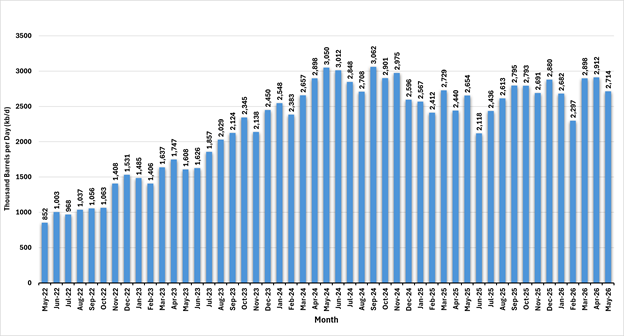
Russia, the largest user of the shadow fleet, increasingly relies on these vessels to maintain oil export revenue. In the spring of 2022, Russia was earning over $100 per barrel on its oil sales, with world spot prices rising higher than $140 per barrel. Following Russia’s full-scale invasion of Ukraine in February 2022, the United States and allied countries imposed various sanctions and embargos targeting Russia’s energy sector, its largest source of export. A central component was the G7 oil price cap, which took effect in December 2022, initially setting a maximum purchase price of $60 per barrel for Russian seaborne crude. As these restrictions tightened, Russia increasingly relied on the shadow fleet to transport crude outside Western sanctions and sustain export revenue. Figure 1 illustrates the growing amount of Russian crude transported by shadow fleet tankers, increasing from approximately 1.53 million barrels per day in December 2022 to 2.60 million barrels per day in December 2024—a 69.6 percent increase.
This trend suggests the shadow fleet became a critical tool to undermine sanctions placed on Russia following the start of the war, as Russia has remained one of the world’s top oil producers, accounting for 8.1 percent of global crude exports alone in 2025. More recently, in May 2026, an estimated 62 percent of Russia’s seaborne crude exports were transported by sanctioned shadow tankers, while another 7 percent were transported by illicit (but not sanctioned) shadow vessels. These estimates were derived by tracking individual tanker movements and Russian oil loadings, then identifying vessels through their IMO numbers and cross-referencing their ownership, insurance, and sanctions status. This suggests that even in 2026, nearly 70 percent of Russia’s seaborne crude was being transported outside the traditional G7+ tanker fleet. This alternative transportation network has allowed Russia to maintain substantial crude exports despite Western restrictions, limiting sanctions’ ability to isolate Russian oil from global markets
Figure 1: Russian Seaborne Crude Oil Exports Transported by the Shadow Fleet (Thousand Barrels per Day)
Source: Kyiv School of Economics – Russian Oil Tracker June 2026
Venezuela
Other sanctioned countries, including Iran and Venezuela, have also relied on shadow fleets to sustain exports despite international laws and sanctions. For example, in January 2026, following the U.S. blockade targeting sanctioned Venezuelan oil, the dark vessel Bella 1 evaded enforcement by renaming itself Marinera and changing its registration from Guyana to Russia. The flag switch allowed Russia to claim the ship and deterred further U.S. action, illustrating how shadow vessels can create geopolitical dilemmas by turning simple sanctions enforcement into possible confrontation with another state.
Iran
Iran continues to serve as an example of how effective the shadow fleet can be at navigating around economic sanctions. Despite years of U.S. sanctions, Iranian oil exports still accounted for 12 percent of China’s overall crude imports in 2025. In February 2026, the U.S. Department of the Treasury sanctioned more than 30 individuals, entities, and vessels, including 12 shadow fleet tankers used to transport Iranian petroleum. These networks facilitated the movement of hundreds of millions of dollars’ worth of Iranian oil, underscoring how enforcement has shifted to continually identifying new vessels, shell companies, and financial intermediaries, rather than the countries purchasing discounted oil.
What Are the Impacts of the Shadow Fleet?
Economic and Geopolitical Impact
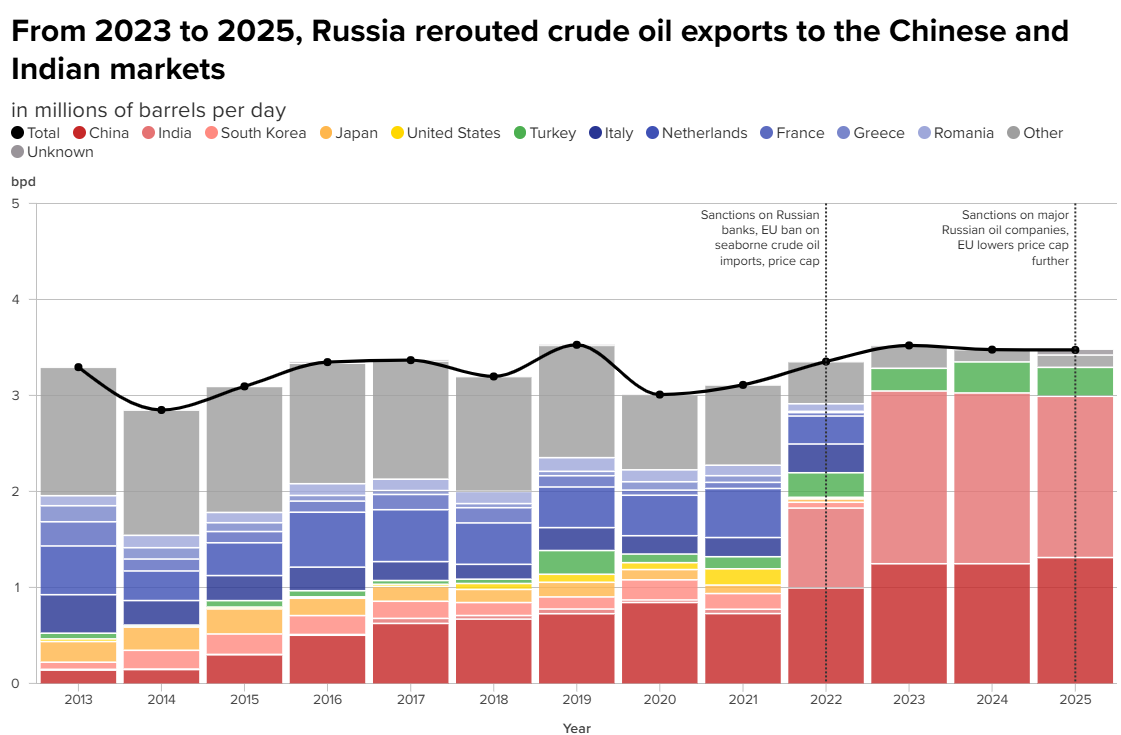
The growth of the shadow fleet has reshaped global oil trade by rerouting petroleum products to alternative markets willing to purchase discounted oil despite Western restrictions. China and India have become the primary destinations for these lower-priced oil exports. Over the past five years, Russia has redirected its crude to Asia, exporting an average of 1.31 million barrels per day to China and 1.68 million barrels per day to India in 2025 (Figure 2). China is also the largest buyer of Iranian crude, importing an estimated 1.38 million barrels per day in 2025, accounting for approximately 12 percent of China’s total crude imports. Sanctioned crude from Iran, Russia, and Venezuela traded at discounts reaching $10–15 per barrel during 2025, allowing China to save an estimated $28.8 million per day at peak discount levels.
Figure 2: Russia’s Rerouted Crude Oil

Source: Atlantic Council – Energy Sanctions Dashboard
More recently, the continued flow of Iranian crude to China during the current U.S.-Iran war further illustrates the role of the shadow fleet in sustaining sanctioned oil exports. Despite increased U.S. pressure on Iran’s petroleum trade, Iranian crude continued reaching China through opaque maritime networks. Following the April 2026 U.S. blockade of the Strait of Hormuz, satellite imagery and vessel tracking data identified 13 tankers conducting STS transfers of roughly 22 million barrels of Iranian crude near Indonesia’s Riau Archipelago, with many of the ships’ cargoes bound for Chinese markets. These exports allow China to secure lower-cost energy and build its oil reserves while providing sanctioned countries with continued access to a major market and critical source of export revenue. This relationship weakens the long-term effectiveness of Western energy sanctions by sustaining demand for sanctioned oil and allowing these trade flows to remain competitive in global markets.
Environmental Impact
The shadow fleet also presents growing environmental and humanitarian risks. Many vessels are out-of-date, inadequately maintained tankers with an increased likelihood of maritime accidents and oil spills. In 2023, Pablo, a 232-meter tanker known for transporting sanctioned Iranian and Russian oil, caught fire and exploded off the southern coast of Malaysia, near Indonesia’s Riau Islands. The explosion killed three crew members and released bunker fuel that contaminated nearly 14 square kilometers of ocean. Environmental and humanitarian incidents such as this one create costs that extend beyond the vessels and oil involved, potentially shifting the burden of cleanup, emergency response, and maritime safety onto governments and coastal communities nearby. Overall, as dark shipping continues, governments must devote more legal, financial, and military resources to preserve the enforcement of international maritime safety regulations.
Policy Considerations to Combat Dark Shipping
Current maritime enforcement strategies are becoming ineffective. Regulatory efforts and sanctions have struggled to keep up with state-backed evasion networks, especially when sanctioned countries possess the financial resources, shipping capacity, and geopolitical support to continually adapt their tactics. Rather than focusing primarily on intercepting shipments and individual vessels, policymakers should place greater emphasis on reducing the demand for sanctioned oil by targeting the economic incentives that encourage major importers such as China and India to continue purchasing it.
The Lindsey O. Graham Sanctioning Russia and Iran Act of 2026, which the Senate passed by a vote of 86-11 in early August, would place additional sanctions on Russia’s energy sector, top leadership, and target the major purchasers of Russian energy, with the aim of stifling Russia’s economy and ending the war in Ukraine. Other provisions of the bill could extend its impact to cover Iran as well. If enacted, President Trump would have broad tariff authority, potentially imposing rates of up to 100 percent on the top five importers of Russian oil and gas. This legislation would likely act as a major deterrent for countries attempting to purchase Russian energy products due to the severe economic consequences they would face through reduced access to the U.S. market. At the same time, if additional tariffs are added, costs would increase for U.S. consumers and businesses, meaning the U.S. economy would also suffer higher prices and reduced growth. Moreover, such tariffs could effectively cut off vital trade partners. Finally, the legislation’s provision of broad enforcement discretion to the president, unclear criteria for identifying major purchasers, and undefined tariff structure weaken its potential effectiveness and create significant implementation challenges. Establishing clearer enforcement standards would strengthen the legislation and could reduce the likelihood of a president misusing the tariff authorities.
Beyond the Senate legislation, U.S. policymakers could reduce the dark fleet by targeting both its existing vessels and its supply of replacements. A clearer licensing process would allow reputable ship recyclers to purchase sanctioned or seized tankers for permanent dismantling, building on the recent U.S.-approved sale of two sanctioned vessels to GMS, an Asia-based company that purchases ships for safe and environmentally responsible recycling. Congress could also require greater due diligence and ownership disclosure when U.S. shipowners sell aging tankers to buyers in high-risk jurisdictions, while encouraging similar restrictions among G7 allies. For example, an analysis of the ownership histories of 75 Russian shadow-fleet tankers found that nearly 60 percent had been sold by Western European owners.Together, these policies could reduce current shadow fleet vessels while making it harder for nations to replace them through Western secondhand markets. As sanction evasion networks continue to evolve, policymakers will need increasingly sophisticated, coordinated, and adaptable strategies to keep pace with these highly resilient illicit maritime networks.
Conclusion
Dark shipping has evolved from a niche sanction-evasion tactic into a significant challenge to U.S. economic and foreign policy, breathing life into the shadow fleet. By enabling sanctioned countries to continue exporting oil through opaque maritime networks, the shadow fleet reduces the effectiveness of Western sanctions while encouraging major exporters to rely on alternative, non-Western trade channels. Beyond undermining international maritime laws, it creates environmental, humanitarian, and security risks that impose growing burdens on governments worldwide. As sanctioned states continue to adapt their shipping practices, the long-term effectiveness of economic sanctions will depend on limiting the ability of hidden trade networks to circumvent international restrictions and maintain access to global markets. Without stronger international cooperation and sustained enforcement, the shadow fleet is likely to remain a persistent feature of global energy trade, continuing to challenge the effectiveness of sanctions as a tool of economic statecraft.


You must be logged in to post a comment.