EXECUTIVE SUMMARY
- Roughly 35 to 45 per cent of federal contract dollars were awarded in FY2025 without full and open competition, and that share has remained steady for a decade.
- The Revolutionary FAR is the federal government’s first-ever comprehensive overhaul of the Federal Acquisition Regulation (FAR), and names increased competition as a goal.
- All seven statutory exceptions to competition, which are anti-competitive, survive the rewrite intact, which means no substantive changes have been made.
INTRODUCTION
The federal procurement process involves acquisition personnel posting solicitations on the federal government’s SAM.gov after determining their agencies’ requirements. This procurement process is guided by the Federal Acquisition Regulation, which is jointly issued by the FAR Council, consisting of the Office of Management and Budget (OMB), Department of Defense (DoD), General Services Administration (GSA), and the National Aeronautics and Space Administration (NASA) administrators. After evaluating offers from interested companies, agencies enter a government contract with companies providing them goods and services.
Competition among potential vendors has long been a point of interest for Congress, which holds the view that increased competition results in lower costs, higher quality goods, increased innovation, and technical capabilities. Increased competition also ensures efficient allocation of American taxpayers’ money, which in turn increases public trust. Maximizing competition, however, comes with its own set of limitations, sometimes clashing with other government procurement objectives. This is where the Competition in Contracting Act of 1984 (CICA) comes into play.
COMPETITION IN CONTRACTING ACT OF 1984
CICA serves as the current framework for competition in federal executive agency procurement. It requires that executive agencies “obtain full and open competition through the use of competitive procedures” for the procurement of goods and services, but it also provides for certain exceptions, which have been widely used from time to time to speed up contracting awards. The seven exceptions are as follows:
- Only one responsible source: This exception allows agencies to limit competition and award a contract to a single entity when “the property or services needed by the executive agency are available from only one responsible source
- Unusual and compelling urgency: This exception can be invoked when the agencies demonstrate that their need for a good or service is of unusual and compelling urgency.
- Industrial mobilization; engineering, developmental, or research capability or expert services: This exception can be invoked to maintain a facility or to acquire expert services.
- International agreement: This exception is invoked when competition is precluded either by terms of an international agreement or a treated by United States and a third party.
- Authorized or required by Statute: This exception is invoked when a “statute expressly authorizes or requires that the acquisition be made through another agency or from a specified source.
- National Security: Competition may be limited under this exception only when the disclosure of the government’s procurement needs poses a security risk
- Public Interest: This exception allows agency heads to award a noncompetitive contract “necessary in the public interest”.
SO, WHAT’S WRONG?
While agencies have used discretion accorded by CICA to award contracts, the numbers do not add up. According to a report by the Congressional Research Service, in FY2025, of the approximately $793 billion in total contract obligations, almost $278 billion (35% of total contract obligations) was obligated on contracts awarded through means “other than full and open competition”. Figure 1 demonstrates that, over the 10-year time span, 33-38% of total contractual obligations have been awarded without competition.
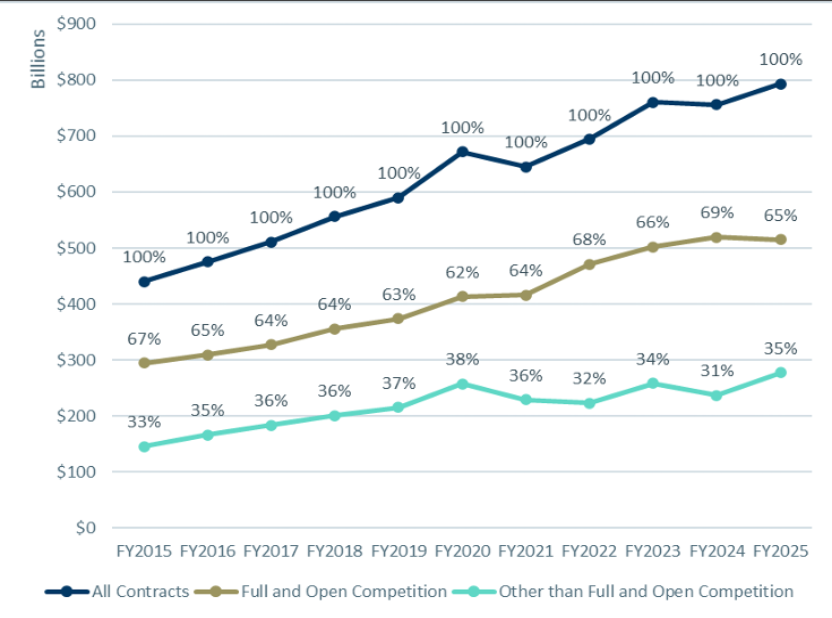
Figure 1: Competitive and Noncompetitive Contract Obligations: FY2015-FY2025
Source: Congressional Research Service
System for Award Management’s data, as reported by the Federal Register, estimates an even higher percentage (45 percent) of contract dollars awarded without competition or with competition that received only one offer (Please note that the above-mentioned figure of 35% is given by the Congressional Research Service; this figure is officially reported on the Federal Register). Upon exploring further on which exceptions are used the most (see Figure 2), the majority were made using the “only one responsible source” exception (73.2% of $271 billion, i.e. $199 billion).
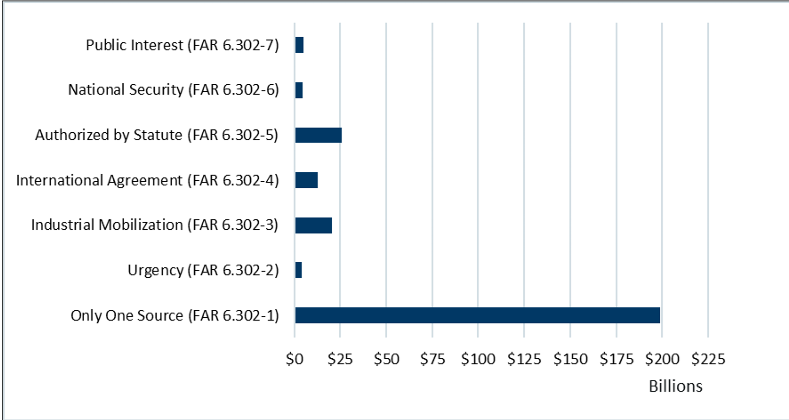
Figure 2: Contract Obligations by Exceptions to Full and Open Competition: FY2025
Source: Congressional Research Service
Another problem is the usage of the “Unusual-and-Compelling-Urgency Exception”. As CRS notes, the breadth of definition for this exception accords agencies with significant discretion in determining whether an actual urgency exists or not. Spending under the “unusual and compelling urgency” exception tells its own story. It spiked to $40.8 billion in FY2021 as COVID-19 emergency contracting took hold, then settled back to a pre-pandemic baseline of $3–5 billion a year by FY2023- DOD and HHS drove most of that surge. The usage of this exception, however, is climbing again: from $4.0 billion in all of FY2025 to $18.4 billion in just the first half of FY2026. This time it isn’t a pandemic; it’s one agency. DHS accounts for 92% of that increase, a jump from $585.5 million in urgency-exception spending for the entirety of FY2025 to a figure that, on a six-month pace, will dwarf it.
THE FIX, ON PAPER
There are several problems associated with the exceptions, so the question is: what is the next step?
President Trump issued Executive Order 14275, titled Restoring Common Sense to Federal Procurement on April 15, 2025. The order focuses on a comprehensive overhaul of the FAR. The goals have been stated clearly: faster acquisitions, greater competition, and better results. Part 6 of the current FAR works in conjunction with CICA and focuses on competition in the federal procurement process. This part needed a substantial revamp for the government to achieve its goals.
The overhaul, which appears significant in “prioritizing clarity and removing redundancy”, however, does not make any substantive changes in the policy. Some of the changes include reducing five subparts to three. The number of sections has been reduced from over 30 to 20. Set-asides for small businesses and women-owned small businesses remain available, but as something a contracting officer may choose to do (discretionary) rather than mandated to do.
On the other hand, all seven statutory authorities for exceptions to competition have been preserved with clearer, more concise language, fewer prescriptive requirements, and removal of examples.
CONCLUSION
While simplification of language makes it easy for interested stakeholders to navigate regulations, any substantive change is yet to be seen. The government’s own numbers put the problem at $278 billion, or 45 percent by its broader measure, and one of the three fixes it named was competition. Part 6 is where it should show up, but it does not (by its own preamble admission). The same seven exceptions survive untouched. Cleaner language is an improvement, but it does not equate to more competition.


You must be logged in to post a comment.