Executive Summary
- In 2025, the United States imposed sweeping tariffs on Canada, including 10 percent tariffs on energy imports such as crude oil, natural gas, electricity, and uranium. Some energy products were later exempted from the tariffs.
- In response to the U.S. tariffs, Canada is expanding its oil pipelines to diversify energy exports toward Asia and reduce reliance on the U.S. markets.
- Canada is an important energy supplier for the U.S. economy, as it supplies over 63 percent of U.S. crude oil imports, more than 99 percent of natural gas imports, and about one-third of uranium for nuclear reactors. U.S. Congress and the administration should keep in mind that predictable and efficient energy trade is beneficial to the U.S. economy.
Introduction
In 2025, the United States and Canada traded an estimated $137 billion in energy products. The United States imported $111 billion in energy from Canada and exported $26 billion in return, with crude oil accounting for 69 percent of the total trade value. In the same year, U.S.-Canada electricity trade totaled $3.2 billion, with U.S. imports from Canada accounting for 67 percent of the value. These numbers reveal a deeply integrated energy market that relies on cross-border pipelines, electricity transmission lines, and U.S. refineries designed to process Canadian crude oil.
This relationship, however, has become more uncertain. In March 2025, Canada’s energy exports to the United States became subject to a 10 percent tariff. Part of energy trade eventually became exempt from tariffs if it qualified for the United States-Mexico-Canada Agreement trade pact preference. In July 2026, the U.S. imposed additional sweeping tariffs on Canada, but exempted energy trade. Even with tariff exemptions, the changing rules add significant uncertainty to the cross-border energy market.
To diversify its economy away from the U.S., Canada plans to expand its pipeline capacity to give oil producers more options to sell overseas. Droughts and higher domestic demand in Canada have also left less power available for export to the U.S. Policies that treat Canada as an adversary risk disrupting the cross-border flow of energy goods that support U.S. energy security and help lower costs.
The United States remains a major energy producer, but the national production numbers can hide regional dependencies. Replacing refineries, pipeline networks, and power grids that rely on Canadian supplies can take significant time and require massive funds.
U.S. Reliance on Canadian Crude Oil
Canada supplied over 63 percent of U.S. crude oil imports in 2025, nearly doubling since 2006. Oil from Canada makes up more than 23 percent of the total U.S. refinery input and 73 percent of Midwest refinery input. Geographic proximity, high pipeline capacity, and the discount that Western Canadian Select (WCS) blend of oil typically trades at relative to U.S. West Texas Intermediate (WTI) make Canadian crude attractive to the American oil industry.
The United States, however, is the world’s largest crude oil producer. What prevents the American refiners from simply switching to the abundant U.S. oil supplies? The issue is that many refineries, mainly in the Midwest and Gulf Coast areas, are specifically designed to process a “heavy” blend of oil. Canada’s oil exports to the U.S. are primarily “heavy” from oil sands, while U.S. production is largely “light” oil. Of about 130 operable oil refineries, 25 consistently use oil from Canada’s Alberta province. Converting them to process light crude would take years and could cost up to hundreds of millions of dollars. Because many U.S. refineries process heavy oil, the U.S. has been also able to export its more valuable light crude oil while refining cheaper Canadian heavy oil at home.
In the past years, Canada has been expanding its pipeline capacity to deliver oil products to other countries. In 2024, Canada’s newly expanded Trans Mountain pipeline nearly tripled the amount of crude oil and refined products that flow from Alberta’s oil regions to the Pacific shipping terminals in British Columbia, expanding access to buyers in Asia. Within the first 12 months of pipeline expansion, crude oil exports through Canada’s West Coast increased by more than six times. The U.S. share of those exports fell from 100 to 51.9 percent, while China accounted for 31.9 percent.
Canada’s Trans Mountain Pipeline Route (Dec 2023)
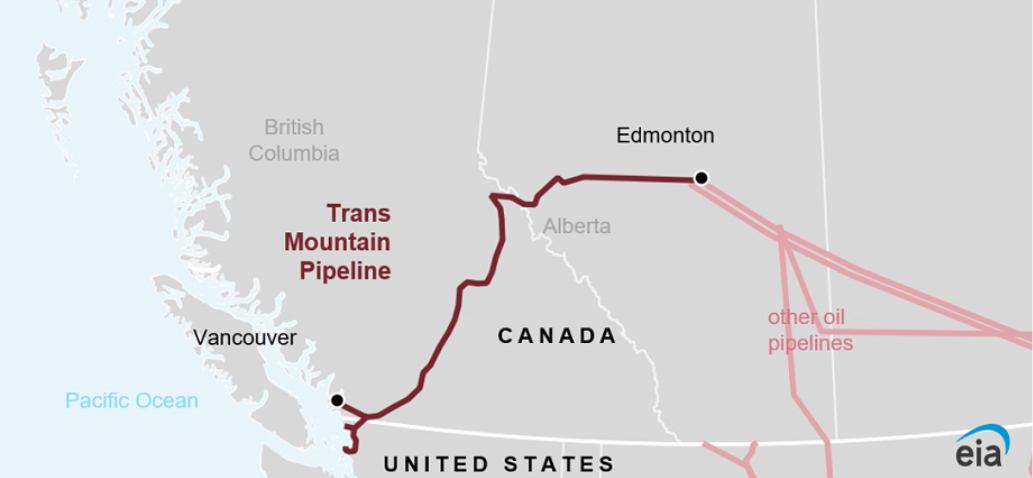
Source: U.S. Energy Information Administration, (2024)
This does not mean that all exports from Canada to the U.S. will be replaced by exports to buyers in Asia, but Canada is clearly willing and able to seek alternative buyers. Although Canada remained America’s largest foreign oil supplier, U.S. crude imports from Canada fell by four percent in 2025 compared to 2024, in part due to Canada’s Trans Mountain Expansion (TMX) pipeline.
Western Canadian Select crude has historically been sold at a discount to U.S. refineries due to limited pipeline infrastructure connecting Alberta to coastal ports and the resulting oversupply of oil in the U.S.-Canada market. If Canadian producers sell more oil overseas, U.S. refineries that rely on those supplies could face more competition for Canadian barrels and higher input costs.
In response to U.S. tariffs, Canada plans to further diversify its oil exports. In October 2026, Canada’s Prime Minister Carney designated the Pacific Link pipeline as a project of national interest, moving it more quickly through permitting process to start construction as early as September 2027. It will transfer one million barrels of crude oil per day to Canada’s West Coast shipping terminal and will be placed next to the existing Trans Mountain pipeline. The project is undergoing review and consultation, so it should be treated as a long-term prospect rather than an immediate change in available oil imports.
Natural Gas
In 2025, Canada accounted for over 99 percent of total U.S. natural gas imports. Most U.S. gas imports from Canada travel by pipelines, primarily entering through western and central border states, specifically Washington, Idaho, Montana, North Dakota, and Minnesota. While the state where Canadian natural gas enters the United States is not necessarily the state where it is consumed, evidence from the EIA and Northwest Gas Association suggests that about two-thirds of natural gas consumed in the Pacific Northwest (Washington, Oregon, and Idaho) comes from Canada. In 2017, California utility customers received 27 percent of natural gas supply from Canada. Canadian natural gas storage also provides additional flexibility for the U.S. during periods of peak demand, particularly in the Northern states, to mitigate extreme winter weather.
Canadian and U.S. Natural Gas Pipelines and LNG Facilities (2026)

Electricity Supply
Canada remains an important electricity supplier to the United States, although its supply has recently declined. The value of electricity trade between the United States and Canada totaled $3.2 billion in 2025, 67 percent of which was electricity imported from Canada into the United States. While electricity imports are small relative to total U.S. electricity consumption, they are important during periods of high demand in the U.S. Northeastern states connected to Canadian power systems.
Hydroelectric generation, which provides over 60 percent of Canada’s electricity, was significantly impacted by droughts in 2025, reducing the surplus of electricity available for the United States. Stronger domestic demand in Canada has also reduced the electricity surplus. Canada, nevertheless, remained a net exporter over that year.
Regions that are the most connected to Canadian power grids are New England and New York. During January 2025, when winter demand peaked, Canadian electricity supplied an average of 14 percent of demand in New England. Over the first eight months of 2025, however, the average was 5 percent. New York’s Canadian imports supplied 11 percent of electricity demand on average between 2016 and 2022, compared with 3 percent in 2024 and about 2 percent in 2025. In May 2026, the Champlain Hudson Power Express transmission line became operational, delivering electricity from Quebec to New York City. It is expected to meet up to 20 percent of the city’s electricity needs, making Canada’s role in Northeastern power markets even more important.
Further U.S. tariffs can lead to retaliatory actions in the electricity markets. One relevant example happened in 2025 when Ontario proposed, then withdrew, a 25 percent tariff on electricity exports to Michigan, Minnesota, and New York in response to trade tariffs initiated by the U.S. From 2015 to 2024, Ontario imports, on average, supplied 4.25 percent of New York’s electricity load.
Uranium
While uranium imports were largely exempted from 2025 U.S.-imposed tariffs, it is vital to recognize the importance of Canadian imports to the U.S. nuclear industry. U.S. nuclear facilities rely almost entirely on imported uranium, and 32 percent of uranium purchased by U.S. for nuclear reactors comes from Canada, making it the top source of imports. In 2025, although U.S. domestic uranium production more than tripled, the U.S. produced only 2.1 million pounds of uranium concentrate, compared with 46.9 million pounds total purchased.
In response to the Russian invasion of Ukraine, the United States banned imports of Russian uranium products in 2024, with waivers available through January 1, 2028. Canadian supply, therefore, matters even more as the United States diversifies away from Russia.
Canada’s impact is important beyond mining and supplying raw uranium concentrate to the U.S., as the Canadian-processed uranium hexafluoride is exported to U.S. to produce enriched uranium used in American light-water nuclear reactors. In 2023, foreign suppliers of uranium hexafluoride accounted for approximately 95 percent of purchases by U.S. nuclear facilities, with Canada being the top supplier at 25 percent.
Conclusion
Canada supplies most of the crude oil, nearly all of the imported natural gas, and about a third of the uranium the United States uses, and it is a key electricity source for the Northeastern states. Numerous U.S. refineries, especially in the Midwest, are built around Canadian heavy crude, and replacing that supply would take years and require millions of dollars.
Canada, primarily in response to the U.S. tariffs, continues expanding trade routes to Asia, while droughts and rising domestic demand inside of Canada are shrinking its electricity surplus available for states. U.S. tariffs and retaliation could weaken the energy ties that provide America with fuel, power, and nuclear fuel supplies. Congress and the administration should keep in mind that predictable and efficient energy trade is beneficial to the U.S. economy.


You must be logged in to post a comment.