Executive Summary: The Federal Trade Commission’s blanket ban on noncompete agreements was finalized in April 2024 but was immediately struck down by the federal court later that year. On September 1, 2026, Representatives Scott Peters (D-CA) and Tom Kean, Jr. (R-NJ) reintroduced the Workforce Mobility Act, which would impose a similar nationwide ban through legislation … Continue reading
Tag Archives: economics
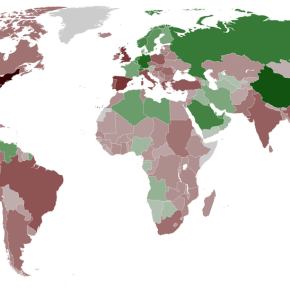
Money Supply and the Current Account: Testing the Predictions of the AA-DD Model
Executive Summary: Policymakers have increased attention to current account deficits. Though experts debate whether current account deficits negatively impact the economy, many have also put forward theories regarding the influence of money supply on the current account. The classic AA-DD model predicts that in the short term, an increase in money supply should result in … Continue reading

The Impact of AI Efficiency Gains on National Debt and Gross Domestic Product
Aryan Mirchandani Executive Summary The recent AI boom has prompted policymakers to forecast exponential GDP growth in the near term, easing pressure on officials to act against rising national debt levels. The Trump Administration has utilized the AI efficiency boom to continue large levels of fiscal spending, as it implores that this boom will decrease … Continue reading

The Trade-Off Behind the Trade Deficit
Executive Summary President Trump aims to rebalance global trade by imposing tariffs and welcoming a weaker dollar because he views the U.S.’ large trade deficit as evidence of unfair trade practices. However, shrinking the trade deficit will shrink the capital account surplus that balances it, thereby weakening the dollar as foreign investors move away from … Continue reading
America / Debt / Economy / Fiscal Cliff / Fiscal policy / Politics / Tariffs / Taxes / Trade / U.S. Domestic Policy
Recession Risk in 2025: A Weighted Logit Model with Policy Insights
An overheating economy, high policy uncertainty, and declining consumer confidence pose recession risks of 53 percent as of April 2025. This paper employs a weighted logit model to aid policymakers in early intervention. Key indicators include consumer expenditure, yield curve, disposable income, and economic policy uncertainty, enhancing prediction accuracy in recession modeling. Continue reading

A Drop in Consumer Sentiment: Economic Consequences and Policy Impacts
Executive Summary The Council of Economic Advisers (CEA) Chair Stephen Miran stated on March 25th he does not believe there is a strong relationship between consumer sentiment and consumer spending in recent years. Miran says this after a 9.76 percent decrease in consumer sentiment from February to March, marking the largest drop since January 2021, … Continue reading

Impact of Retail Electricity Deregulation on Consumer Prices: A Difference-in-Difference Approach
Executive Summary Electricity is a necessary commodity for nearly every person in the United States, and while the delivery process has not changed, deregulation has altered who supplies it. Historically, electrical markets were vertically integrated and regarded as a natural monopoly, but recent market-oriented reforms have aimed to deregulate and introduce competition to lower both … Continue reading

Debt / Economy / Fiscal policy / Trade
The Twin Deficit Hypothesis: An Analysis of the U.S.
Executive Summary The relationship between fiscal deficits and trade balance in the United States is complex, and the twin deficit hypothesis (TDH) and Ricardian equivalence hypothesis (REH) suggests two differing opinions on the relationship. The TDH postulates a positive connection between fiscal deficits and trade balance (net exports) while the REH argues there is no … Continue reading

Are the Elderly Hurt More by Inflation? A Glimpse Inside the Housing Market
Executive Summary Recent CPI-U and CPI-E (age 62+) data suggests the elderly have experienced higher CPI growth over the same period, and the heightened rate is likely from a greater weight in the shelter component of CPI which accounts for the housing costs of those who both own and rent their properties. Homebuying trends have … Continue reading

Yes, “Gig City’s” Public Broadband is Fast, but its Economic Future is Questionable
Executive Summary The impacts of Covid-19 will continue to elicit conversation about funding municipal broadband projects, so we must be aware of the long-term financial obligations associated with these programs. Chattanooga’s public broadband produces speeds much faster than the national average, but the economic responsibility looms far into the future. The financial structure of the Electric Power Board’s public broadband will be difficult to duplicate, so the Chattanooga program should not be used as … Continue reading


You must be logged in to post a comment.