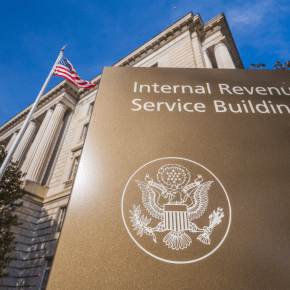
EXECUTIVE SUMMARY• The Trump administration furloughed almost half of Internal Revenue Services (IRS) employees and issued 1,300 layoffs during the October 2025 shutdown.• The cuts have delayed implementation of the One Big Beautiful Bill (OBBB), making Republicans’ tax-simplification effort appear inefficient and disorganized.• Businesses and individuals now face higher costs as they rely more on … Continue reading
Tag Archives: Finance
Money Supply and the Current Account: Testing the Predictions of the AA-DD Model
Executive Summary: As part of his rationale for increasing tariffs, President Trump has focused on the U.S.’s trade deficits. Experts have long debated whether trade deficits matter; some argue a trade deficit simply signals that the region is attractive to foreign investment and has strong consumer demand, while others have instead contended that a trade … Continue reading
The Impact of AI Efficiency Gains on National Debt and Gross Domestic Product
Aryan Mirchandani Executive Summary Introduction Historically, only a few technological innovations have created anticipation that rivals the likes of artificial intelligence, which has catapulted the first phase of the new productivity revolution. Proponents of AI argue that it will streamline workflows, enhance decision-making, and unlock rapid efficiencies across wide-ranging industries. The Trump Administration is making … Continue reading
Treasury Outlines OBBB Tax Implementation as Compliance Costs Remain Elevated
EXECUTIVE SUMMARY• Department of the Treasury briefed House of Representatives lawmakers on the schedule for rolling out tax provisions of the One, Big, Beautiful Bill (OBBB).• Internal Revenue Service (IRS) paperwork data show that core returns and schedules tied to these provisions require 3.5 billion hours and over $139 billion annually in compliance costs.• Compliance … Continue reading
Stablecoin Issuers as a Growing Class of Treasury Buyers: Implications and Risks
Executive Summary Introduction Congress’ recent passage of the GENIUS Act, the first significant regulatory framework for stablecoins, opens the door for increased crossover between traditional finance and cryptocurrency, or decentralized finance. The law sets a framework for future stablecoin regulation and prohibits interest-bearing stablecoins and prevents big tech and retail firms from issuing stablecoins without … Continue reading
The Trade-Off Behind the Trade Deficit
Executive Summary Introduction President Trump has long called for the U.S. to impose higher tariffs to reduce the trade deficit, which he has declared a national emergency. His administration announced unprecedented unilateral tariffs to reverse what it alleges are unfair trade practices. This strategy ignores the accounting principle known as the balance of payments: The … Continue reading
We Know Little About Post-2012 Oil Shocks
Note this post was written on June 17, 2025 and does not reflect subsequent events. EXECUTIVE SUMMARY INTRODUCTION High oil prices are top of mind these days for good reason. Brent oil prices have spiked more than 12% from $64 per barrel at the beginning of June to $72—mostly on fears of a Strait of … Continue reading
Recession Risk in 2025: A Weighted Logit Model with Policy Insights
An overheating economy, high policy uncertainty, and declining consumer confidence pose recession risks of 53 percent as of April 2025. This paper employs a weighted logit model to aid policymakers in early intervention. Key indicators include consumer expenditure, yield curve, disposable income, and economic policy uncertainty, enhancing prediction accuracy in recession modeling. Continue reading
A Drop in Consumer Sentiment: Economic Consequences and Policy Impacts
Executive Summary Introduction The Council of Economic Advisers (CEA) provides research and analyses to the Executive branch to inform policy directives. CEA Chair Stepehen Miran appeared on CNBC on March 25th amid economic uncertainty, stating he does not believe there is a strong relationship between consumer sentiment and consumer spending. Consumer sentiment is tracked in detail by … Continue reading
Impact of Retail Electricity Deregulation on Consumer Prices: A Difference-in-Difference Approach
Executive Summary Introduction Electricity has become the most fundamental commodity in the United States. Its growing influence underpins nearly every major industry. It powers homes, infrastructure, and manufacturing. Innovation and technological development for the entire economy depends on efficient and reliable energy transmission. Utilities markets in the U.S. have historically been viewed as natural monopolies. … Continue reading
You must be logged in to post a comment.