Politics

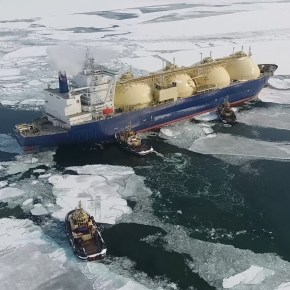
Don’t Be Crude! Inside the Shadow Fleet’s Illicit Global Trade Network

Executive Summary “Dark shipping” practices weaken the effectiveness of economic sanctions and create significant environmental, humanitarian, and geopolitical risks. The “shadow fleet” transported approximately 3.7 billion barrels of oil in 2025, representing nearly 7 percent of global crude oil flows. These vessels allow sanctioned countries to circumvent sanctions, preserve billions of dollars in export revenue, … Continue reading →

Politics

UNCLOS and Arctic Seabed Competition: Does U.S. Non-Ratification Strengthen or Weaken Its Position Relative to Russia?

Executive Summary: U.S. non-ratification of UNCLOS preserves regulatory autonomy by avoiding key obligations under Article 82 and the International Seabed Authority (ISA), including revenue-sharing requirements for extended continental shelf exploitation and deep-seabed mining. However, non-ratification prevents the United States from submitting Arctic continental shelf claims to the Commission on the Limits of the Continental Shelf … Continue reading →

Politics

Economic Sanctions – Modern Tool Against Modern War?

Introduction Economic sanctions represent one of the most widely used instruments in international relationships for various social, political and military concerns. They can be imposed by one country (unilateral sanction) or group of multiple countries (multilateral sanction) against other country (or regime) to express their disapproval of the regime and deter the unacceptable behavior.   However, … Continue reading →

Clinton’s Secretary of State Shortlist Reveals Her Foreign Policy
Central Asia / China / Dpt. of State / Europe / Europe / Foreign Policy / Iran / Middle East / National Security / Presidential Race 2016 / Russia / Sanctions

Clinton’s Secretary of State Shortlist Reveals Her Foreign Policy

  The Clinton transition team recently leaked its shortlist for Secretary of State. While media attention has solely focused on Vice President Joe Biden’s appearance on the list, the rest of the list reveals what a potential Clinton administration’s foreign policy might entail. Based on her shortlist, Clinton has Russian aggression and European stability on … Continue reading →

Politicking National Security: A Hack Job
Dpt. of State / Foreign Policy / National Security / Politics / Presidential Race 2016 / Russia

Politicking National Security: A Hack Job

In case you missed it, a presidential candidate invited a foreign government to break into either a private citizen’s email account and steal information or break into the servers at the United States Department of State. I am in a state of disbelief. These were his words (with my editorial comments in parentheses): Russia, if … Continue reading →

In Space Everyone Can Hear You Compete
Technology

In Space Everyone Can Hear You Compete

  After years of fighting, the Senate has reached a compromise regarding the use of Russian rocket engines for U.S. military space launches.  The agreement lifts the ban implemented in the 2015 National Defense Authorization Act until 2022, after which the Pentagon can no longer issue launch contracts to firms using Russian made rockets.  “Firms,” … Continue reading →

On Ukraine: US Strength is Putin’s Demise
Foreign Policy / National Security / Politics / Russia / Sanctions

On Ukraine: US Strength is Putin’s Demise

Since the collapse of the USSR, Russia has felt backed into a corner and neglected by the international community and, indeed, has been. First, there was the quick snatching-up of post USSR states into the EU with no chance of admission for Russia. Next, there was the absolute refusal of Russian integrity by NATO, and … Continue reading →

Ukraine: The New Cold War Battleground
Dpt. of State / Europe / Events / Foreign Policy / National Security / Politics / Russia / Sanctions / UN

Ukraine: The New Cold War Battleground

Tensions in Ukraine have been running high since ousted president Viktor Yanukovych brokered an economic deal with Russia in November, spurring month-long protests that eventually led to the overthrow of the government. A new, pro-West Ukrainian government was installed last week, naming Oleksandr Turchinov as president and opposition leader Arseniy Yatsenyuk as prime minister until … Continue reading →

The Ripple Effects of Obama’s Disastrous Syria Policy
Foreign Policy / Middle East

The Ripple Effects of Obama’s Disastrous Syria Policy

Nearly everyone, regardless of personal political beliefs, will agree that President Obama’s stance(s) on Syria has been perplexing.  Syria’s conflict began back in March 2011 as a popular uprising during the Arab Spring.  As the conflict transformed into a civil war, rumblings grew for international intervention.  On August 20, 2012, Obama stated that his red … Continue reading →