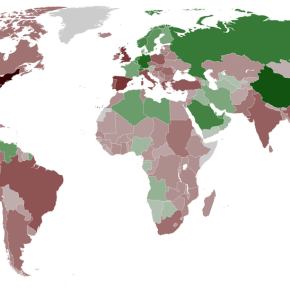
Executive Summary: Introduction On October 9th, China imposed export controls on rare earth minerals and related technologies. Since then, rare earth minerals have been dominating news headlines, with many experts espousing the importance of reducing the U.S.’s dependence on China for these minerals. The Trump administration’s policies have heavily focused on rare earth minerals too; … Continue reading
Category Archives: Politics
Money Supply and the Current Account: Testing the Predictions of the AA-DD Model
Executive Summary: As part of his rationale for increasing tariffs, President Trump has focused on the U.S.’s trade deficits. Experts have long debated whether trade deficits matter; some argue a trade deficit simply signals that the region is attractive to foreign investment and has strong consumer demand, while others have instead contended that a trade … Continue reading
The Impact of AI Efficiency Gains on National Debt and Gross Domestic Product
Aryan Mirchandani Executive Summary Introduction Historically, only a few technological innovations have created anticipation that rivals the likes of artificial intelligence, which has catapulted the first phase of the new productivity revolution. Proponents of AI argue that it will streamline workflows, enhance decision-making, and unlock rapid efficiencies across wide-ranging industries. The Trump Administration is making … Continue reading
Betting on Trade: Prediction Markets & Tariff Uncertainty
Executive Summary: On February 1st, 2025, Trump signed an executive order imposing tariffs on imports from Mexico, Canada, and China. Two days later, Trump agreed to a 30-day pause on these trade threats. Since then, Trump has announced a myriad of tariffs, many of which he has paused or completely revoked in the following days. … Continue reading
Trump’s policies will increase home prices in a long-suffering housing market
Executive Summary Introduction There is a housing supply shortage in the United States which is skyrocketing home prices. The Federal Reserve Bank of Atlanta’s Home Ownership Affordability Monitor reached 64 for the total U.S. market in May 2025. This is the lowest number on record and well below 100, the benchmark for “affordable.” In January … Continue reading
The GENIUS Act Should Apply to Yield-Bearing Stablecoins As Well
Note this post was written July 11, 2025 and does not reflect subsequent developments. EXECUTIVE SUMMARY INTRODUCTION During the Biden administration, the SEC cracked down on cryptocurrencies by asserting that all tokens—regardless of their function—were unregistered securities. This aggressive stance left crypto issuers and exchanges in regulatory limbo. The SEC refused to issue clear rules … Continue reading
‘Golden share’ of U.S. Steel extends president’s reach into the private sector
Executive Summary Introduction On June 18, the Japanese firm Nippon Steel finalized a “historic partnership” with U.S. Steel (USS), acquiring the company for nearly $15 billion. This came after years of Biden and then Trump blocking the purchase due to national security concerns. The deal was finally allowed soon after President Trump was promised a … Continue reading
We Know Little About Post-2012 Oil Shocks
Note this post was written on June 17, 2025 and does not reflect subsequent events. EXECUTIVE SUMMARY INTRODUCTION High oil prices are top of mind these days for good reason. Brent oil prices have spiked more than 12% from $64 per barrel at the beginning of June to $72—mostly on fears of a Strait of … Continue reading
House Bill Includes Costly Reforms to Health Reimbursement Arrangements & Health Savings Accounts
Executive Summary Introduction On May 22, 2025, the House of Representatives passed a budget reconciliation bill – referred to as the “One Big Beautiful Bill Act” – which includes many key provisions relating to health care policy. While the proposed changes to Medicaid and the Affordable Care Act garner more public attention, the additional changes … Continue reading
Recession Risk in 2025: A Weighted Logit Model with Policy Insights
An overheating economy, high policy uncertainty, and declining consumer confidence pose recession risks of 53 percent as of April 2025. This paper employs a weighted logit model to aid policymakers in early intervention. Key indicators include consumer expenditure, yield curve, disposable income, and economic policy uncertainty, enhancing prediction accuracy in recession modeling. Continue reading
You must be logged in to post a comment.