Executive Summary
- The Council of Economic Advisers (CEA) Chair Stephen Miran stated on March 25th he does not believe there is a strong relationship between consumer sentiment and consumer spending in recent years.
- Miran says this after a 9.76 percent decrease in consumer sentiment from February to March, marking the largest drop since January 2021, coupled with heightened economic uncertainty stemming from Trump policy initiatives.
- This paper incorporates regression analyses and concludes the 9.76 percent drop in sentiment amounts to a decrease in 7.92 billion dollars of expenditure for the month, with the annualized growth rate of expenditure slowing by 0.92 percentage points from 3.13 to 2.21 percent.
Introduction
The Council of Economic Advisers (CEA) provides research and analyses to the Executive branch to inform policy directives. CEA Chair Stepehen Miran appeared on CNBC on March 25th amid economic uncertainty, stating he does not believe there is a strong relationship between consumer sentiment and consumer spending. Consumer sentiment is tracked in detail by the Michigan Survey of Consumer and provides insight into how Americans feel about the health of economy. This discussion has been spurred by the largest drop in consumer sentiment since January 2021. Heightened levels of uncertainty around economic policy initiatives have created concern for an imminent recession, especially with the looming impact of the Trump Administration’s current tariff policy. With the February decrease in sentiment, consumer expenditure is predicted to drop nearly 8 billion dollars in the upcoming month.
Previous Views on Sentiment
Historically, consumer sentiment has acted as an important macroeconomic indicator for policymaking. It is used to track consumer feelings of uncertainty in the economy, as it is an aggregate measure of consumers’ thoughts on the health of the economy. The Survey of Consumers includes variables like index of consumer sentiment, index of consumer expectations, index of current economic conditions, and the expected change in prices in one year. A 2009 study from the Chicago Federal Reserve finds an increase in consumer sentiment predicts an increase in consumer expenditure across all income groups. Sentiment is a valuable measure because consumer expenditure amounts to around two-thirds of U.S. Gross Domestic Product (GDP), or around 20 trillion dollars in 2024. How a consumer expects the economy to perform will determine how they interact with the economy. In recessions consumers tend to save more as a precautionary measure. When consumers feel more confident in the economy, they are more likely participate at higher rates and spend more money in it. This study relays the important notion consumer willingness to pay is determined by their views on the economic health of the country.
Stephen Miran’s comments and the recent sentiment data renew the debate on the connection between sentiment and expenditure.
What does the Data Say?
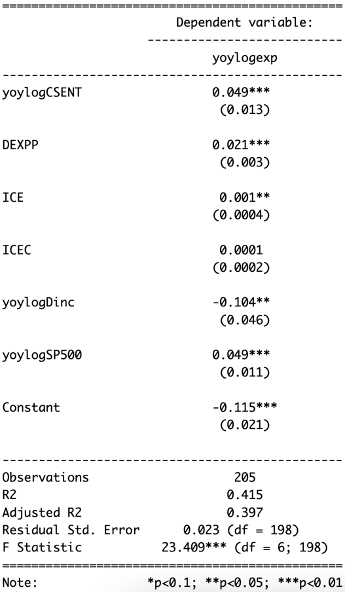
The regression performed in this paper includes the following variables:
- Consumer expenditure (exp)
- Consumer sentiment (CSENT)
- Index of current economic conditions (ICEC)
- Index of consumer expectations (ICE)
- Expected change in price level over the next year (DEXPP)
- S&P500 level (SP500)
This paper uses a linear regression to pinpoint the effect of sentiment on the expenditure level. A Pearson correlation test provides a moderate relationship between expenditure and sentiment with a coefficient of 0.27. The regression coefficient on sentiment is 0.0487 and is statistically significant. As consumer sentiment increases by one percent year over year, consumer expenditure is predicted to increase by 0.049 percent year over year, holding all else constant. With the recent sentiment data showing a 9.76 percent decreases, this amounts to a drop in consumer expenditure equal to 7.92 billion dollars in the next month.
This data and previous research both counter Stephen Miran’s claim about the relationship between the two variables. With the data currently available, the effects are already starting to be felt. Expenditure data from January to February shows an annualized decline of 36.4 billion dollars.
The Influence of Uncertainty on Sentiment
Public uncertainty is quantified in the Economic Policy Uncertainty Index provided by the Federal Reserve. This index tracks key phrases used in news outlets which contribute to uncertainty in economic policy. Since October 2024, the index has more than doubled from 97 to 233 points. The index is currently above the levels seen in the 2008 financial crises and trending towards levels experienced during the Covid pandemic. Uncertainty in economic policy is without a doubt on the rise.
Recent changes in consumer sentiment stem from the Trump administration’s economic policy directives. This administration is moving quickly, and consumers and businesses alike are not able to respond before another change is proposed. Being in a state of economic uncertainty contributes to low sentiment. Uncertain environments do not provide positive outlooks on the economy. Incomplete information garnered from an uncertain environment strengthen consumer’s lowering sentiment.
Labor market uncertainty introduced by the Department of Government Efficiency’s (DOGE) attempts at axing federal budgets by firing workers has many asking questions. Although not a large part of the workforce, publicly firing these positions has likely contributed to heightened economic uncertainty. A decrease in one’s personal financial situation lends itself to greater uncertainty in the economy.
The main source of economic uncertainty is Trump’s tariff policies. From general tariffs, steel and aluminum, alcohol, and autos, consumers are left wondering what the impact will be. Numerous estimates are readily available, but it is difficult for the individual consumer to gauge the impact on their specific bundle of goods. Many sources confirm the cost of tariffs are passed through to the consumer in the form of higher prices. Uncertainty around the impact of tariffs at the individual level are likely a key driver of the current decrease in consumer sentiment.
An additional factor contributing to lower sentiment and higher uncertainty is how the current trade war impacts the United States’ standing with their allies and the global economy. Since the end of World War II, the global economy has become more connected and supply chains more interdependent. Violating the United States and Mexico Canada Agreement (USMCA) by implementing steep tariffs on products has not been received kindly by allied countries. Additionally, the policy trend towards protectionism removes the incentives for countries to do business inside the United States. Trade is a beneficial agreement because no single country has a comparative advantage in producing every good its citizens require. This has left the U.S. consumer to wonder where their products are going to come from, and at what price.
These factors have contributed to declining consumer sentiment and consumer’s outlook on the economy. With all these changes happening so quick, the influence on sentiment and subsequent decrease in consumer expenditure are likely to be significant.
Impacts on the Economy
Declining consumer sentiment and the following declining expenditure impacts all contributors to the economy. The aggregate effects lend itself towards a recession, and each sector makes rational decisions based on their individual circumstances.
When consumers are faced with higher uncertainty and lower sentiment, they tend to save more and spend less in the economy. A recent study indicates greater economic uncertainty increases the likelihood of a recession event. Uncertain economies stimulate precautionary saving. Precautionary saving is a forward looking activity consumers participate in where their anticipated outlook on economic health is lower than their current levels. This causes them to save more money in the current period to prepare for the future. This action reduces expenditure, and expenditure is an integral part of the business cycle. Drastic decreases in expenditure can contribute to the likelihood of a recession.
Businesses also respond differently to decreased sentiment. They must be set cost and production expectations according to predicted changes in sales and revenues. If businesses estimate these differences poorly, which is more likely in the face of economic uncertainty, they either lose out in profits or have unfavorable margins. Recent studies also confirm economic uncertainty decreases production levels in an attempt to be financially cautious. Less expenditure from consumers will ultimately lead to lower performance and lower stock prices for publicly traded companies. Lower sentiment leads to lower expenditure and therefore poor performance creating a vicious cycle stemming from consumer expectations and sentiment.
Policymakers should monitor sentiment closely as an indicator for macroeconomic trends. Stephen Miram’s statement induces worrisome comments as the data suggests sentiment and expenditure are related. Policymakers must navigate between expansionary monetary policy which may induce inflation, and contractionary monetary policy which has the potential to induce a recession. Expansionary policy is favored in times of economic uncertainty and low inflation, but the current economic situation requires a more nuanced approach, which might cause a delay in action.
Because of lower consumer sentiment, consumers and businesses are forced to make decisions in an uncertain economic environment. The combination of decisions made in economic uncertainty and low sentiment increases the likelihood of a recession event.
Conclusion
An environment of economic uncertainty fosters lower consumer sentiment. Lower consumer sentiment at small levels does not have a large impact on expenditure, but the most recent sentiment data provides reason for concern. With an already decreasing sentiment and predicted additional drop in nearly 80 billion dollars of consumer expenditure next month, one must look at the causes of sentiment and uncertainty. Policy directives which seem erratic have contributed to a rise in uncertainty, and economic history does not favor uncertain environments. Still above the inflation target, economic policymakers must choose carefully the right path to take. Confidence in the economy will ease consumers and business’ decision making, but with the implementation of new executive economic policy, expenditure is likely to fall while prices rise.
 Policy Interns
You must be logged in to post a comment.